How Much Instagram Outages Cost Your Business
Instagram outages are striking roughly once a month in 2026, costing businesses up to $10,000 per day and creators hundreds to thousands per incident. This article compiles the data marketing leaders need to build a defensible business case for contingency budgeting and channel diversification.
Checking Instagram outage status is no longer a niche task for the social team. In 2026, the operating question is whether the business knows how much revenue, paid media efficiency, partner delivery, and creator income are exposed when Instagram or the wider Meta stack stops working.
That does not mean Instagram is suddenly a bad channel. It remains one of the largest commercial attention markets in the world: Instagram generated an estimated $66.9 billion in ad revenue in 2024, around 40% of Meta’s total revenue, and reaches 3 billion monthly active users.[1] The dependency exists because the platform works. The risk is that many teams budget as if it will always work at the exact moment a launch, sale, booking window, creator drop, or paid campaign needs it to.
The defensible budget question is not “will Instagram go down again?” It is “how much exposure are we carrying, who can act when the platform fails, and have we funded the fallback?”
The 2026 outage pattern is now too frequent to treat as weather
Between March and July 2026, the public outage record shows repeated Instagram or Meta disruptions, including March 11, June 12, July 19, and July 22 incidents. The wider public record identifies five significant disruptions in that period, but the accessible, source-backed incidents below are the ones a marketing lead can safely take into a planning conversation without overstating the record.
| Date | Affected surface | Known signal | What the source proves |
|---|---|---|---|
| March 11, 2026 | Instagram messaging and app access | Downdetector reports peaked at 10,108; 71% of reports cited app problems and 20% cited server connection errors | A measurable Instagram disruption occurred, with messaging and app reliability prominent in user reports.[2] |
| June 12, 2026 | Meta services, including Facebook and Instagram | CNET covered a Meta-wide outage affecting Facebook and Instagram | The incident was visible enough to receive live consumer tech coverage, but the source does not quantify business losses.[3] |
| July 19, 2026 | Global Meta services, including Facebook and Instagram | Reuters reported users suffering outages on Meta’s Facebook and Instagram | A global Meta disruption affected access for users, supported by wire-service coverage.[4] |
| July 22, 2026 | Instagram direct messages | Tom’s Guide ran live updates on an Instagram DM outage | The disruption centered on Instagram messaging and was current enough to require live status coverage.[5] |

That table matters because each source answers a different question. Downdetector-style report volumes show user-reported disruption, not lost revenue. Reuters coverage confirms that a disruption reached global news relevance, not that every market or account was equally affected. Live coverage from CNET or Tom’s Guide confirms a current service problem, not the financial damage to a given advertiser, creator, or ecommerce business.
This is exactly where budget conversations often go soft. A leadership team can dismiss one outage as an exception. Four publicly documented incidents in roughly four and a half months, with the wider record pointing to five significant disruptions in the March-to-July window, is harder to file away as rare. The status-monitoring habit, the backup channel, and the authority to pause spend should not depend on someone noticing angry posts in Slack.
The clearest loss figures are older, but they are still useful
The cleanest documented business-loss examples do not come from 2026. That caveat belongs near the top, not in a footnote. Public reporting has not produced a reliable 2026 dataset that says, for example, the July 19 Meta outage cost the median Instagram-dependent brand a specific amount. Anyone turning the 2026 outage reports into a precise loss calculator is pretending to have data that is not public.
But the opposite mistake is just as expensive: refusing to budget for a known operating risk because the newest public record is heavier on outage signals than revenue disclosures. The documented loss cases are older, yet they show the size of damage that can occur when a business has real commercial dependency on the platform.
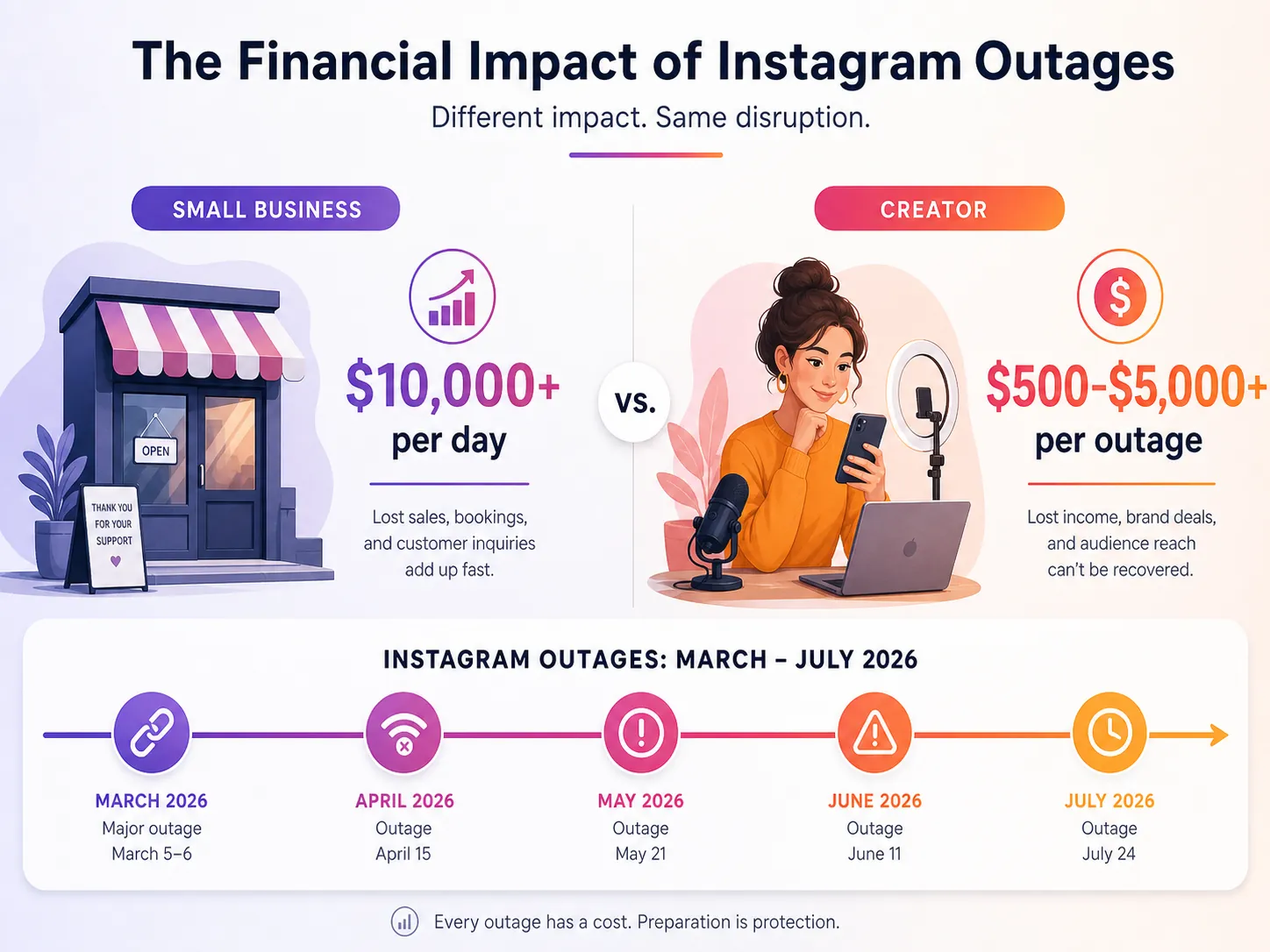
During a 2019 Facebook and Instagram outage, The Verge documented one brand reporting a $10,000 single-day loss tied to the disruption.[6] During the 2021 six-hour Meta outage, CNBC interviewed 10 creators and small business owners and reported losses ranging from $500 to more than $5,000 per creator per outage.[7]
Those numbers should not be copied into a 2026 forecast as if nothing has changed. They are not an average, not a benchmark by vertical, and not a guarantee that a given business will lose the same amount. They are better used as documented severity examples: proof that Instagram and Meta outages have already produced day-level losses large enough to matter to a small business, creator, or campaign owner.
| Evidence | What it supports | What it does not support |
|---|---|---|
| $10,000 single-day loss reported by one brand during a 2019 Facebook and Instagram outage | A platform outage can create five-figure daily exposure for an Instagram- or Facebook-dependent business.[6] | It does not prove that $10,000 is the typical 2026 loss for all brands. |
| $500–$5,000+ losses reported by creators and small business owners after the 2021 six-hour Meta outage | Creators and small operators can lose meaningful income during a single outage window.[7] | It does not provide a statistically representative creator-loss average. |
| Four accessible 2026 incident sources from March through July | Instagram or Meta disruptions are recurring enough in 2026 to justify operational planning.[2][3][4][5] | They do not disclose account-level revenue loss. |
For a business case, that distinction is a strength. A credible request does not need to claim that every outage will cost exactly $10,000. It needs to show that the probability is no longer theoretical and that the downside has documented commercial consequences.
Where the cost actually shows up
The visible outage is usually a feed that will not load, DMs that will not send, or ads traffic that looks wrong. The business cost lands in less tidy places.
- Launch windows compress: a product drop, event registration push, or creator activation loses the hours when the audience was primed to act.
- Paid media loses decision quality: teams may not know whether weak performance reflects creative fatigue, conversion friction, tracking issues, or platform instability.
- Partner obligations get messy: agencies, affiliates, creators, and brand partners may have deliverables scheduled around a platform that is not available.
- Customer service backlogs move elsewhere: when DMs fail, customers often look for email, web chat, comment threads, or another platform.
- Reporting gets harder: someone has to explain a dip that was caused partly by infrastructure and partly by the team’s inability to reroute fast enough.
For ad teams, the immediate execution question is what to do with spend while Instagram is unstable. That belongs in a playbook, not in the budget memo. Once the business case is approved, the practical companion is What to Do With Your Instagram Ads When the Platform Goes Down.
Use broader outage data as context, not Instagram proof
The wider internet reliability picture supports the case for contingency planning, but it should not be misused. Cloudflare detected 174 major internet outages worldwide in 2025, averaging more than three per week, according to a summary citing Cloudflare Radar.[8] The same source reports Uptime Institute data showing that 54% of organizations said their most recent significant outage cost more than $100,000, and one in five exceeded $1 million.[8]
Those figures are not Instagram-specific. They do not tell a social media manager what the next DM outage will cost. They do help leadership understand why platform reliability belongs in operational risk planning rather than as an informal concern owned by whichever marketer happens to be online when reports spike.
The October 20, 2025 AWS outage is a useful reminder of how dependency can cascade: the incident affected 113 services for more than 15 hours, according to the same outage-statistics summary.[8] A marketing organization does not need to become an infrastructure team. It does need to know which parts of its revenue motion depend on platforms it does not control.
How to frame the budget request
The strongest business case does not ask for “more diversification” in the abstract. It names the exposure, names the fallback capacity, and separates one-time setup from ongoing operating work.
| Budget line | What it funds | Why it is defensible |
|---|---|---|
| Owned-audience capture | Email and SMS capture paths, preference centers, landing pages, and creator or campaign CTAs that do not rely only on Instagram | CNBC documented creators and small business owners pivoting to LinkedIn, email, and owned websites after the 2021 Meta outage.[7] |
| Channel diversification | A practical presence on secondary platforms where the same audience can still be reached during a disruption | Sprout Social reports that more than 90% of consumers are active on multiple platforms, which supports reach redundancy without assuming identical behavior across channels.[9] |
| Status monitoring | A named process for checking Instagram status, Downdetector signals, Meta service updates where available, and internal performance anomalies | The 2026 incident record shows that waiting for informal complaints is not a reliable detection system.[2][3][4][5] |
| Outage-response authority | Pre-approved rules for pausing, shifting, or annotating spend and partner deliverables during instability | The cost of delay is not only wasted spend; it is also poor reporting judgment during a known service issue. |
| Backup campaign infrastructure | Non-Instagram landing pages, email sends, alternate creative crops, partner messaging, and reporting annotations ready before launch day | Contingency assets are cheapest before the outage and most politically expensive after revenue misses. |
A workable budget argument can be built without pretending to know the exact future loss. For example, a marketing lead can model exposure by identifying the campaigns most dependent on Instagram during a given quarter, the revenue or pipeline those campaigns are expected to influence, the hours or days when timing matters, and the minimum cost of rerouting attention through owned or secondary channels. That model will still be imperfect, but it is more honest than treating the platform as a free reliability layer.
What not to overclaim
- Do not say the 2019 $10,000 loss is the standard 2026 daily cost for brands; use it as a documented severity case.[6]
- Do not say the 2021 creator losses are representative of all creators; CNBC interviewed 10 creators and small business owners, which is useful but not a market-wide sample.[7]
- Do not use Cloudflare’s 174 major internet outages as an Instagram outage count; it is broader reliability context.[8]
- Do not confuse outage reports with confirmed lost sales; reports establish disruption signals, not account-level revenue impact.
The decision is whether to fund resilience before the next review
The evidence is not perfect. The best public revenue-loss examples are from 2019 and 2021. The 2026 record is stronger on frequency than on disclosed financial damage. Broader outage-cost research explains operational stakes, not Instagram-specific losses.
That is still enough to justify a budget line. Instagram and Meta disruptions have appeared repeatedly in 2026, documented outages have already cost businesses and creators real money in prior incidents, and the commercial surface area of Instagram is too large to leave fallback capacity as an unfunded expectation.
Waiting for a cleaner 2026 loss dataset is itself a dependency decision. It means the next outage will be handled with the same improvised monitoring, unclear spend authority, and fragile channel mix that made the last one more expensive than it needed to be.
References
- Instagram Revenue and Usage Statistics, Business of Apps, 2026
- Instagram Down: Messaging Outage March 2026, Anaxis Digital
- Facebook, Instagram Outage June 12, 2026, CNET, June 12, 2026
- Users of Meta's Facebook, Instagram report suffering some outages, Reuters, July 19, 2026
- Instagram down outage live updates 7/22/26, Tom's Guide, July 22, 2026
- Facebook and Instagram went down and small businesses lost thousands in revenue, The Verge, March 14, 2019
- Facebook and Instagram outage hurt creators, small businesses, CNBC, October 9, 2021
- Internet Outage Statistics, SQ Magazine
- Social Media Crisis Management, Sprout Social
This is a record of what happened and what was tested, not legal advice. Compliance determinations require qualified counsel.