
A Marketer's Playbook for Handling Instagram DM Outages
When Instagram DMs go down, response speed determines whether you lose customers or keep them. This three-phase playbook tells you exactly what to do in the first 15 minutes, during the outage, and after restoration.
If Instagram DMs are down right now, do not start by debating whether Meta is having a “real” outage. Start by protecting the customer who is already waiting. Confirm that the issue is not limited to your account or device, put a visible notice somewhere customers can still see, pause anything automated that might invite more replies into a broken inbox, and move active conversations to a channel that still works.
That is the practical answer for marketers handling an Instagram DM outage: confirm, redirect, recover. The order matters because each phase prevents a different kind of damage.
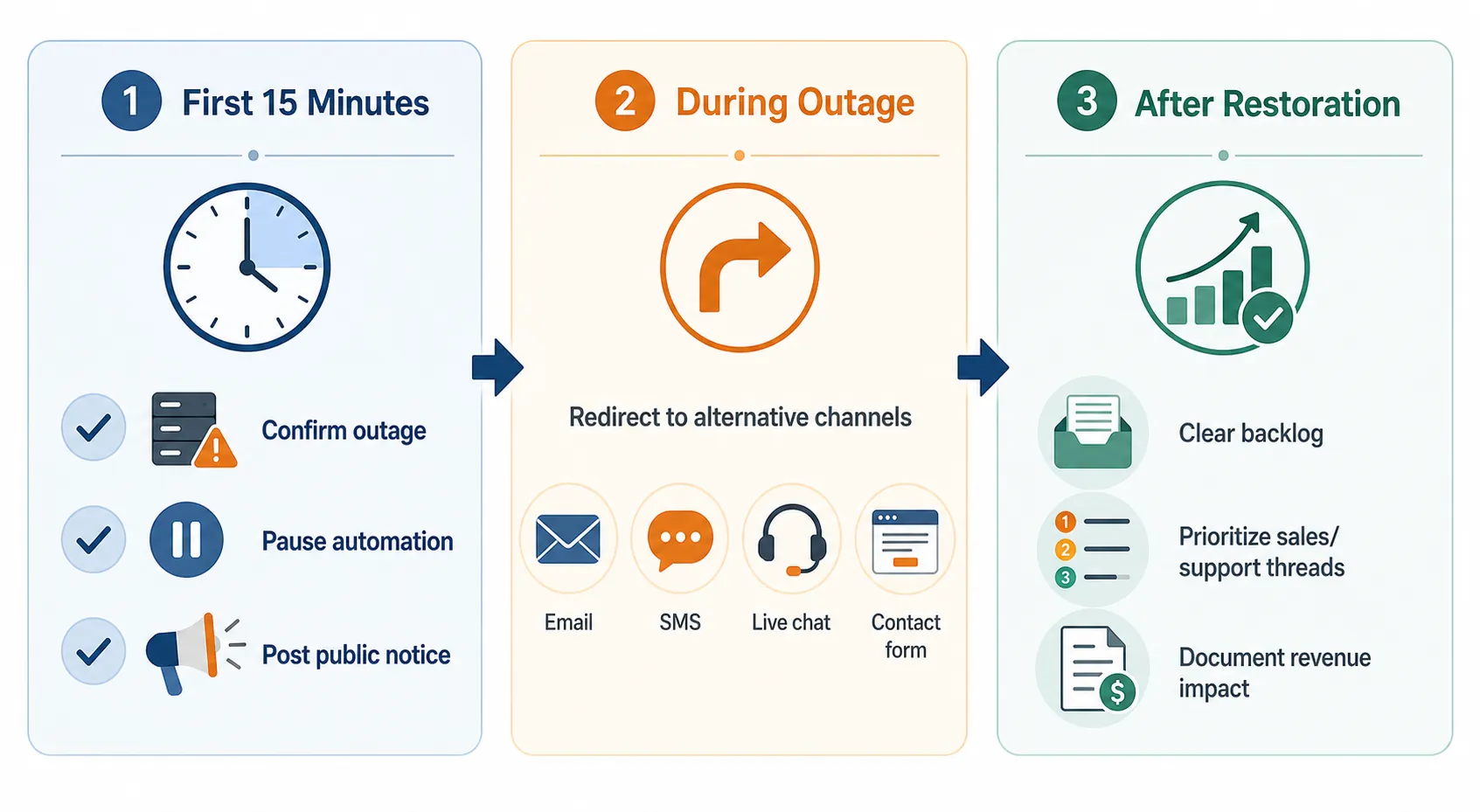
| Phase | What to do | What you are preventing |
|---|---|---|
| First 15 minutes | Check whether it is your account, device, network, or a wider Instagram issue. Alert support, sales, paid media, and leadership. Pause risky automation. | False alarms, duplicated work, and customers being sent into a broken DM thread. |
| During the outage | Post a public notice and route people to email, SMS, WhatsApp Business, live chat, or a website form. | Customers assuming they are being ignored and moving to a competitor. |
| After restoration | Clear the backlog by priority, document missed or delayed responses, and save timestamps/screenshots. | Lost sales staying invisible and the same scramble repeating next time. |
This is no longer a rare edge case. On March 11, 2026, Forbes reported roughly 13,000 Instagram outage reports, with users unable to post or send DMs.[1] On June 12, CNBC reported around 10,000 Instagram reports alongside about 113,000 Facebook outage reports.[2] A lighter July 19 incident gave social teams another reminder that the inbox can disappear during normal business hours, even if public detail was thinner than the March and June coverage.
The stakes are not cosmetic. Sprout Social reports that 35% of U.S. consumers use Instagram for customer service, and 73% say they will buy from a competitor if a brand does not respond on social.[3] Vendor-published LeadResponse data also claims Instagram DMs can see 90% open rates, 60% reply rates, 7% to 20% DM-to-sale conversion, and 150 million monthly business-user messages; useful context, as long as it is treated as vendor data rather than independent proof of every brand’s results.[4]
First 15 Minutes: Confirm Before You Announce
The first job is to decide whether you are looking at an Instagram outage or an account-level problem. That sounds obvious until three Slack threads appear at once: paid media asks whether to pause campaigns, support asks whether to tell customers to email, and the founder asks whether anyone else is seeing the same thing.
Give one person ownership of the check. Not the whole social team. Not everyone with the Instagram password. One owner should run the diagnostic and post updates in one internal thread.
- Check Instagram DMs on mobile data and Wi-Fi.
- Check from the Instagram mobile app and desktop web.
- Check whether feed posting, comments, Stories, and profile access still work.
- Ask one teammate with account access to test from a different device.
- Run the 60-second web check in Instagram DMs Not Loading? Here's the Marketer's Fix before calling it a platform outage.
Then compare your symptoms with public signals. Downdetector-style spikes are useful because they show whether many users are reporting the same failure at the same time. In the March 2026 outage, Anaxis Digital cited a report mix where 71% involved general app problems and 20% involved server connection issues, which is the kind of pattern that tells you the problem is probably wider than your phone cache.[5]
Do not wait for perfect certainty before preparing the response. You need enough confidence to stop making the situation worse. Sprout Social’s crisis planning guidance emphasizes pausing automated content, aligning cross-functional responders, and communicating through owned channels during social crises.[3] Hootsuite’s crisis management guidance also treats internal roles, message approval, monitoring, and post-crisis review as core parts of the response.[6]
The Internal Message Should Be Boring and Specific
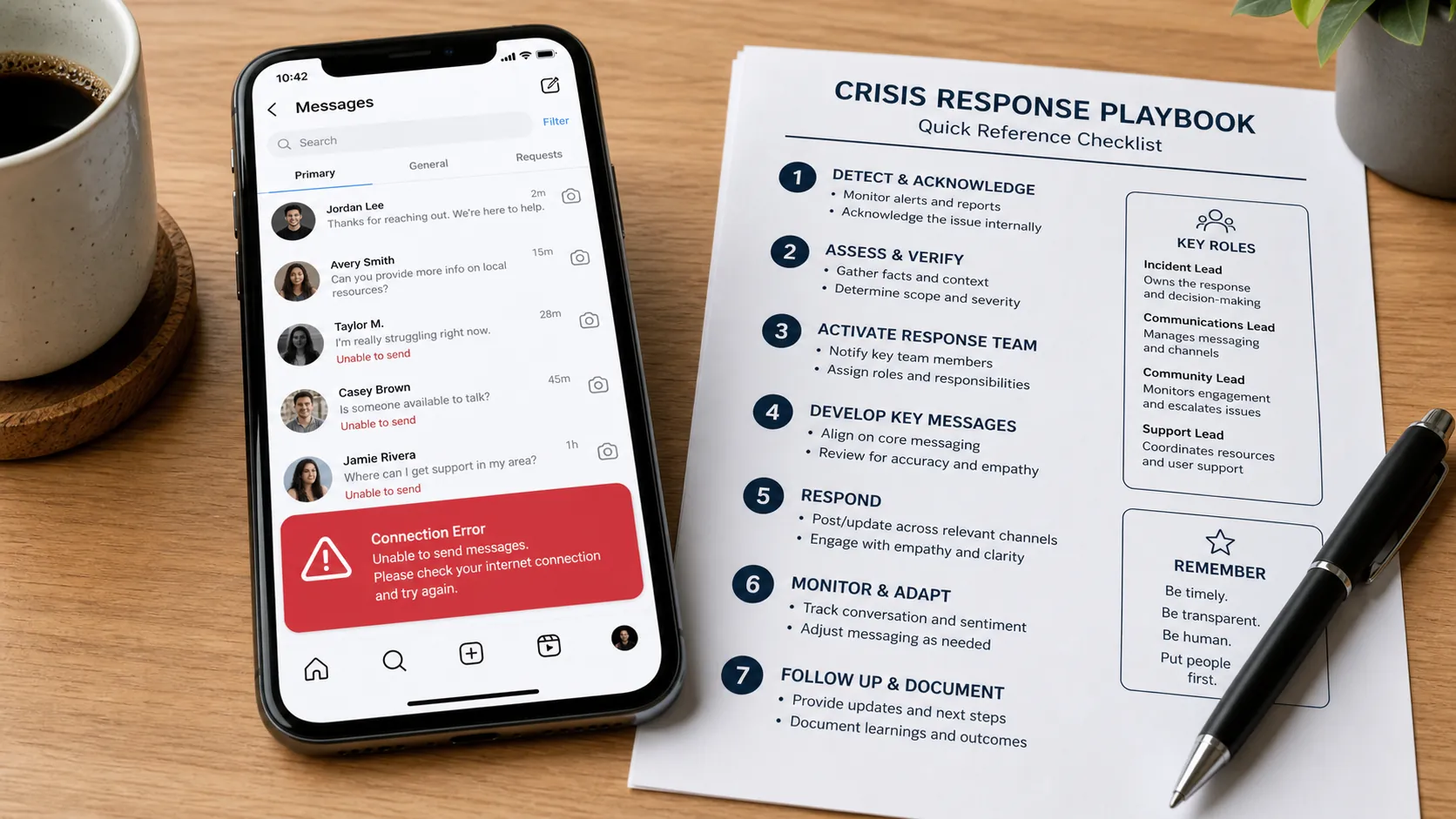
The internal update does not need drama. It needs a timestamp, what is broken, what still works, who owns the next update, and what the team should stop doing.
[10:14 a.m. ET] Instagram DMs are failing for our account on mobile and desktop. Feed and Stories are still loading. Public outage reports are rising. Support lead: Maya. Social lead: Jordan. Next update: 10:30 a.m. ET. Pause DM-based automations and do not direct customers to IG DMs until cleared.That message saves time because it answers the first questions before they become meetings. It also gives support permission to stop apologizing blindly and start routing customers somewhere useful.
During the Outage: Move Customers Before They Feel Ignored
Once you have a credible outage signal, the priority changes. You are no longer diagnosing. You are reducing unanswered demand.
Put a public notice where customers are most likely to look while DMs are unreliable. Depending on what still works, that could be an Instagram Story, a pinned comment, a feed post, your website banner, a support page, an email alert, or another social profile. The language should be calm, current, and channel-specific.
Instagram DMs are currently unreliable, so replies here may be delayed. For order help, email [email protected]. For urgent delivery changes, use live chat on our site. We will update this post when DMs are working again.Avoid promising that Meta will fix anything by a certain time unless Meta has said so publicly. Your job is not to forecast the platform. Your job is to tell customers where they can get an answer now.
Pause Anything That Creates More Broken Conversations
Scheduled content can become a trap during a DM outage. A launch post that says “DM us for sizing” or an ad that sends users into Instagram messages creates demand your team cannot serve. Pause or edit anything that points to DMs until you know the inbox is stable.
- Pause click-to-message ads if they route to Instagram DMs.
- Pause auto-replies, keyword flows, giveaway bots, and DM-based lead magnets.
- Review scheduled posts for phrases like “DM us,” “message us,” or “send us your order number.”
- Tell creators, affiliates, and launch partners not to direct followers to Instagram DMs until cleared.
This is where preventable confusion usually gets expensive. The paid media manager may not know DMs are failing. The influencer coordinator may have a Story going live in ten minutes. The support rep may be the only person who can see the queue getting angry. Put the pause in writing and give it an owner.
Choose the Replacement Channel by Customer Need
Alternative channels are not a consolation prize. Meta/Kantar business messaging statistics cited by ChatMaxima say 72.4% of consumers are more likely to purchase from brands that offer messaging, and 73.3% of online adults prefer messaging as their primary way to communicate with businesses.[7] The point is not to force every customer into email. The point is to give them a working path that fits the reason they contacted you.
| Customer need | Best redirect option | What to say publicly |
|---|---|---|
| Order status or returns | Support email or website contact form | For order help, email us with your order number so the support team can track the request. |
| Urgent delivery changes | Live chat or SMS, if staffed | For urgent delivery updates, use live chat on our site for the fastest response. |
| Sales questions | Website chat, WhatsApp Business, or a sales inbox | For product questions while DMs are down, message us on WhatsApp or use site chat. |
| Wholesale, partnerships, or press | Dedicated email alias | For business inquiries, email [email protected] until Instagram messages are restored. |
| Community comments | Pinned comment or Story update | We are monitoring comments while DMs are unreliable and will move private issues to email. |
Be careful with privacy. Do not ask customers to put order numbers, addresses, phone numbers, or payment problems into public comments. If comments are the only visible surface still working, use them to move people to a private non-Instagram channel.
Keep the Notice Updated
A stale outage notice starts to look like abandonment. If the outage continues, update the timestamp even when there is no major news. That tells customers someone is still watching.
Update, 12:05 p.m. ET: Instagram DMs are still unreliable for our team. Please continue using [email protected] for order issues and live chat for urgent delivery changes. We are tracking delayed Instagram messages and will reply when access returns.If your team has enough coverage, assign one person to public updates and another to the replacement inbox. The worst split is making the same support rep monitor Instagram, email, live chat, and Slack while also writing the executive update.
What Not to Do While DMs Are Unstable
Most outage mistakes are small, fast, and avoidable. They happen when a team tries to look responsive without changing the path customers are using.
- Do not keep telling customers to “DM us” from comments, Stories, ads, or creator posts.
- Do not let automated replies promise response times your team cannot meet.
- Do not publish cheerful launch content without acknowledging that the main support channel is impaired.
- Do not diagnose publicly with guesses about Meta’s systems.
- Do not make support wait for executive approval to post a basic service notice if the template was pre-approved.
The 2021 Meta outage showed how severe platform dependence can feel for small operators: TIME reported on a clothing designer who said 95% of site traffic came from Instagram and 100% of income came from the platform at that time.[8] That case is older than the 2026 outages, but the dependency pattern is still recognizable to anyone whose customer service, launches, and sales conversations all sit in the same inbox.
After Restoration: Clear the Queue Like It Has a Cost
When DMs return, do not just tell the team “we’re back.” Restoration is the start of the recovery phase, not the end of the incident.
First, verify stability. Send and receive a test message from the brand account. Check whether old messages load, whether replies send, and whether automations resume correctly. If messages are appearing out of order or disappearing after refresh, keep the public notice live and continue using the backup channel.
Then triage the backlog. Chronological order feels fair, but it is not always the best service order after an outage. Start with the threads where delay is most likely to cost the customer money, time, or trust.
- Urgent order changes, delivery issues, cancellations, payment problems, and safety-related support.
- High-intent sales questions from active campaigns, launches, drops, or limited inventory windows.
- Customers who contacted multiple channels and may need duplicates merged.
- General product questions, community replies, collaborations, and lower-urgency requests.
Use a short recovery reply rather than pretending nothing happened.
Thanks for your patience. Instagram DMs were unreliable earlier today, so we are catching up now. I’m reviewing your message and will help from here.If the customer already emailed, chatted, or texted during the outage, acknowledge that too. Duplicate replies are almost as irritating as no reply because they tell the customer your systems are not connected.
Document the Incident While the Evidence Is Fresh
Save the boring artifacts: screenshots, timestamps, public outage links, internal Slack updates, ad pause times, notice copy, and the time DMs appeared stable again. If you had to pause campaigns, note which ones. If a launch window was affected, note the window. If support response times slipped, record the delay.
You are not building a courtroom file. You are making sure the cost of the outage does not vanish as soon as the inbox starts loading. For a fuller financial case, use How Much Instagram Outages Cost Your Business after the immediate cleanup is done.
Turn the Response Into a Reusable Plan
A good outage plan should fit on one page. It should name the diagnostic owner, the public update owner, the support escalation owner, the paid media owner, the approved backup channels, and the pre-approved language for each channel. If it takes twenty minutes to find the plan, it is not a plan.
| Plan item | Decision to make before the next outage |
|---|---|
| Outage trigger | What combination of failed tests and public reports is enough to activate the plan? |
| Internal owner | Who posts the single source-of-truth update in Slack or Teams? |
| Public notice | Which channels can publish a service notice without fresh executive approval? |
| Backup routes | Which customer needs go to email, SMS, WhatsApp Business, live chat, or forms? |
| Automation pause | Who can pause DM flows, scheduled posts, and click-to-message ads? |
| Recovery record | Where do screenshots, timestamps, missed leads, and delayed replies get stored? |
Instagram outages are frequent enough, and customer-response stakes are high enough, that a pre-written DM outage plan is now basic operating infrastructure. It is not a platform-diversification manifesto. It is the document that keeps one broken inbox from turning into a full day of preventable confusion.
References
- Instagram Down: New Outage Leaves Users Unable To Post Or DM, Forbes, March 11, 2026.
- Meta’s social networks down for thousands of users, CNBC, June 12, 2026.
- Social media crisis plan: How to protect your brand, Sprout Social.
- Instagram DM Statistics 2026, LeadResponse.
- Instagram Down: Messaging Outage March 2026, Anaxis Digital, March 2026.
- Social media crisis management: 9 steps for your brand, Hootsuite.
- Business Messaging Statistics 2026, ChatMaxima.
- The Facebook Outage Was a Nightmare for Small Businesses, TIME, 2021.
This is a record of what happened and what was tested, not legal advice. Compliance determinations require qualified counsel.