
How IBM's AI Strategy for Marketing Automation Works Today
IBM no longer competes as a marketing automation campaign platform — its current AI strategy targets the infrastructure layer. This article explains what watsonx, Orchestrate, and governance tools actually mean for enterprise marketing stacks.
If you came looking for IBM’s AI strategy for marketing automation because you need email journeys, landing pages, lead nurture, segmentation, and campaign reporting, the clean answer is uncomfortable but useful: IBM is probably not the campaign platform you are trying to buy.
That does not make IBM irrelevant to marketing automation. It means IBM now sits in a different part of the stack. Its current AI strategy is aimed at the infrastructure around marketing operations: building AI capabilities, orchestrating work across systems, governing model use, and helping large organizations implement custom workflows. That is a very different job from replacing Marketo, HubSpot, Salesforce Marketing Cloud, or Adobe campaign applications.
The confusion is understandable. IBM did have a real campaign-management history. But the business boundary changed years ago: IBM sold a portfolio that included Unica and other on-premises software assets to HCL in 2018, and then sold Watson Marketing and related marketing automation assets to Centerbridge Partners in 2019, as TechTarget reported at the time.[1]
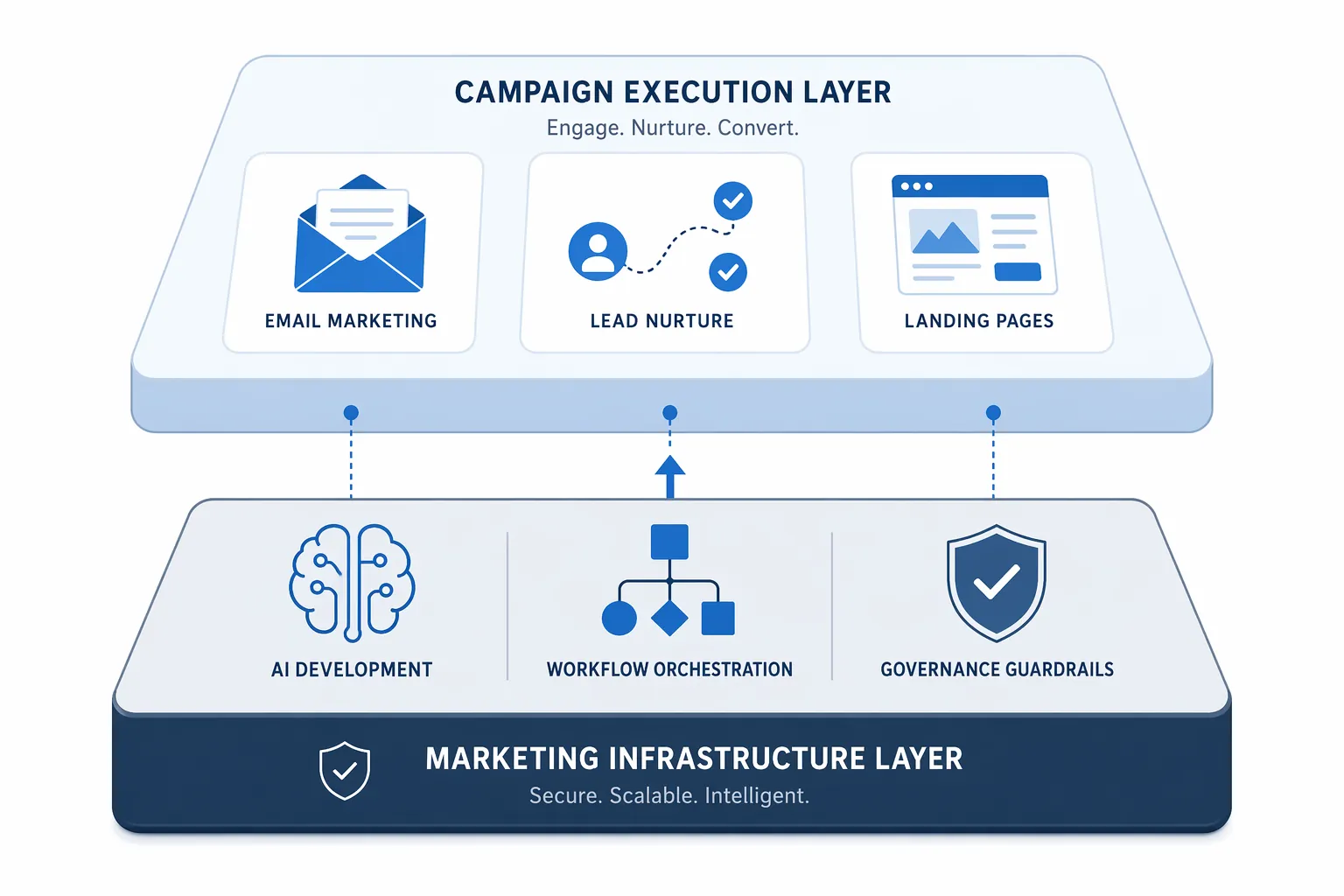
The category error: campaign application vs. enterprise AI layer
Marketing automation buyers usually mean one of two things when they use the phrase. The first is a campaign application: build a segment, trigger an email, score a lead, route a handoff, report on campaign performance. The second is a broader operating layer: connect data, generate assets, coordinate approvals, enforce governance, and move work between marketing, sales, legal, analytics, and agencies.
IBM’s current strategy belongs mostly to the second meaning. That distinction matters because the implementation burden is completely different. A campaign platform gives marketers a UI for repeatable execution. An AI infrastructure layer gives technical and operations teams the ingredients to build, govern, and connect custom capabilities.
| Stack layer | What the marketing team expects | Where IBM fits today |
|---|---|---|
| Campaign execution | Email programs, nurture flows, forms, landing pages, campaign reporting | Not IBM’s primary current position |
| AI development | Custom models, assistants, content and workflow capabilities | watsonx.ai |
| Workflow and agent orchestration | Agents that pass work across tools, teams, and approvals | watsonx Orchestrate and related orchestration capabilities |
| AI governance | Controls, oversight, risk management, policy enforcement | watsonx.governance |
| Enterprise implementation | Process design, integration, operating model, change management | IBM Consulting |
This is why a leadership team can hear “IBM AI marketing automation” and imagine one thing, while the marketing operations team inherits something else. The former is imagining a replacement platform. The latter has to wire together identity, data access, model permissions, approval logic, brand controls, CRM handoffs, and reporting continuity.
What IBM is actually selling into the marketing stack
The relevant IBM architecture for marketing starts with watsonx.ai, not with a campaign canvas. In marketing terms, watsonx.ai is the place an enterprise team would look when it wants to build or adapt AI capabilities: content assistants, analytics copilots, knowledge retrieval experiences, campaign-planning support, or other internal tools that need to respect enterprise data boundaries.
watsonx Orchestrate is closer to the operational pain that marketing teams feel every week. Its value is not “send this email at 9 a.m.” It is more like: take a request, gather required inputs, call the right agent or application, move the next task to the right person, and keep the work inside an approved process. IBM has been positioning Orchestrate around agent management, multi-agent workflows, and governance guardrails rather than around a marketer-facing campaign builder.
watsonx.governance addresses the part of AI marketing that tends to get under-modeled in vendor demos: oversight. IBM’s Think 2026 coverage positioned governance as a central part of its enterprise AI direction, alongside broader watsonx platform updates.[2] For a regulated or highly matrixed marketing organization, that can be more important than another generative copy feature. Someone has to decide which model can touch which data, which outputs require review, what gets logged, and how exceptions are handled.
IBM Consulting is the fourth piece, and it should not be treated as an afterthought. The kinds of marketing workflows IBM is best suited to support are rarely plug-and-play. They usually cross systems and departments: product marketing briefs, legal review, web publishing, localization, sales enablement, partner content, field marketing requests, and analytics feedback loops. That work needs process design before it needs another AI input field.
The Adobe partnership shows the placement more clearly than the positioning language
The clearest evidence of IBM’s current layer in marketing is not a broad AI claim. It is the Adobe relationship announced in June 2025. Adobe described the partnership as bringing IBM watsonx into Adobe Experience Platform and connecting watsonx Orchestrate with Adobe’s Agent Orchestrator.[3]
That is a revealing architecture. Adobe remains the experience and marketing-application environment. IBM contributes AI, orchestration, and enterprise implementation capability around it. In practical terms, that means IBM is not asking a marketing team to abandon its campaign system and move into an IBM-branded campaign suite. It is trying to make itself useful inside and around the systems enterprises already run.
For stack evaluation, that is the useful buying clue. If the enterprise already has Adobe Experience Platform, Salesforce, a CDP, a DAM, a consent platform, and a service layer full of approvals, IBM may enter as connective tissue. If the team has no mature campaign platform at all, IBM is not the fastest route to basic marketing automation.
Where the Creative Assistant case is useful — and where it is not
IBM’s Creative Assistant case is worth paying attention to because it describes actual marketing work changing, not just platform ambition. IBM says the tool had more than 1,010 active users and generated more than 7,000 asset drafts across more than 10 content formats.[4]
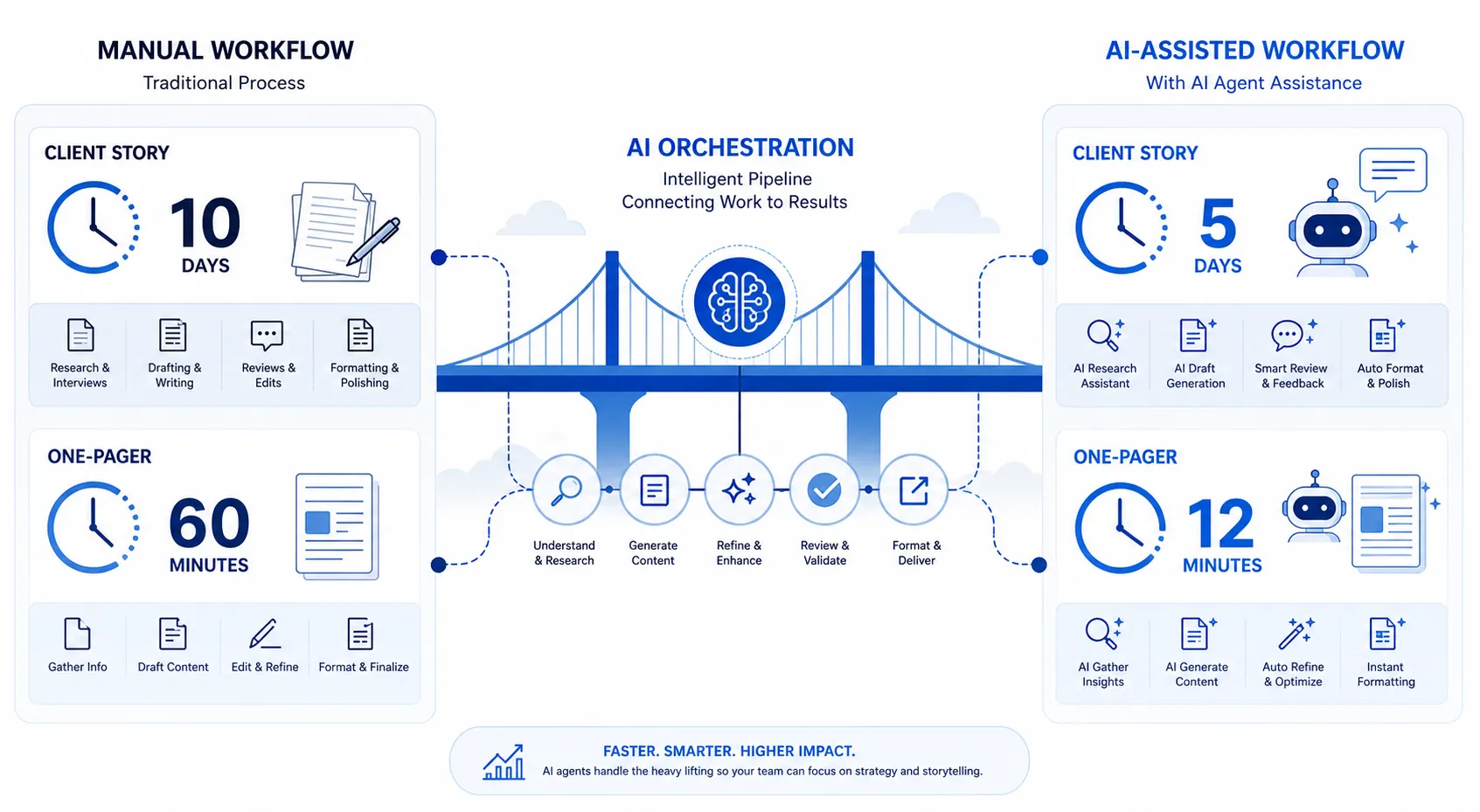
The reported workflow changes are concrete: IBM says client story production moved from 10 days to 5 days, a 50% reduction, and one-pager creation moved from about 60 minutes to about 12 minutes, an 80% efficiency gain.[4] Those are the kinds of numbers a marketing operations leader can translate into queue pressure, reviewer capacity, and production planning.
They should still be read correctly. These are IBM-reported case-study outcomes, not independently audited proof that every enterprise content team will cut production time in half. The more defensible conclusion is narrower: IBM’s approach can support custom marketing production workflows when the organization has enough volume, governance need, and implementation discipline to make a specialized assistant worthwhile.
That distinction is not academic. A small demand generation team struggling to launch webinars does not necessarily need an enterprise AI assistant. It may need better campaign templates, cleaner CRM fields, and fewer approval loops. A global enterprise with multiple business units, brand constraints, legal review, and reusable content formats is a more plausible fit for the kind of system IBM is describing.
What IBM would not replace
The safest way to evaluate IBM is to list the work it should not be expected to own. If the requirement is “let marketers build automated email journeys without engineering support,” IBM is not the natural shortlist leader. If the requirement is “launch landing pages, score leads, sync campaign members, and report pipeline influence,” a conventional marketing automation platform still belongs at the center.
- For email nurture and campaign execution, evaluate platforms built for campaign operators.
- For lead management and CRM-connected revenue operations, evaluate the marketing automation and CRM ecosystem together.
- For landing pages, forms, and simple segmentation, avoid turning an infrastructure project into a basic tooling decision.
- For AI governance, cross-system orchestration, and custom agents, IBM becomes more relevant.
This is also where procurement language can create trouble. “AI marketing automation” sounds like one budget line. In practice, it may involve a campaign platform, a data layer, identity and consent systems, asset management, orchestration tooling, model governance, and services. IBM can credibly participate in several of those layers. It should not be treated as a single-platform answer to all of them.
The scale numbers are context, not the buying argument
IBM has large AI momentum, and it is fair to include that context in an enterprise evaluation. At Think 2026, IBM discussed a generative AI book of business of $12.5 billion.[2] IBM’s Institute for Business Value has also pointed to $4.5 billion in internal productivity gains from AI and hybrid cloud.[5]
Those numbers say IBM is operating at enterprise AI scale. They do not, by themselves, prove marketing automation fit. A marketing stack decision should still come back to workflow specificity: which systems need to be connected, which users will work in which interface, which approvals remain human, which model risks need governance, and what the existing campaign platform already does well.
A practical fit test for IBM in marketing automation
IBM belongs in the conversation when the marketing problem has crossed from campaign execution into enterprise operating design. The more the work depends on custom agents, multi-system handoffs, policy controls, and implementation support, the stronger the fit becomes.
- IBM is a plausible fit when marketing needs AI agents that draw from approved enterprise data and operate across multiple business systems.
- IBM is a plausible fit when orchestration matters more than another campaign-builder screen.
- IBM is a plausible fit when governance, auditability, risk management, and role-based control are mandatory rather than optional.
- IBM is a plausible fit when consulting-led implementation is acceptable because the workflow is too specific for an out-of-the-box tool.
- IBM is a weak fit when the team mainly needs standard email automation, forms, landing pages, campaign reporting, and CRM-connected lead nurture.
The buying conclusion is therefore narrower than the keyword suggests. IBM’s AI strategy for marketing automation is relevant for enterprises building the systems around campaigns. It is not a replacement for the platforms marketers use to run the campaigns themselves.
References
- IBM marketing automation sell-off represents market shift, TechTarget
- Live from Think 2026, IBM
- Adobe and IBM Enable Businesses to Unlock AI-Powered Creativity and Marketing, Adobe, June 2025
- IBM Creative Assistant, IBM
- AI and automation, IBM Institute for Business Value
This is a record of what happened and what was tested, not legal advice. Compliance determinations require qualified counsel.