
The Marketing Math Behind Robinhood's Platinum Card
Robinhood's Platinum Card offers over $3,000 in benefits on a $695 fee. This article explains how the card is designed as a customer acquisition engine for its brokerage and banking ecosystem, making it a marketing investment rather than a profit center.
Robinhood launched its invite-only Platinum Card on July 22, 2026, with a $695 annual fee and more than $3,000 in stated benefits, including unlimited 3% cash back and partner perks tied to WHOOP, Function Health, Amazon One Medical, Eight Sleep, and statement credits.[1][2] That is the shiny part. The useful question is less shiny: who is expected to absorb the subsidy if a premium cardholder actually uses the benefits?
That is where most coverage of Robinhood Platinum Card benefits marketing gets too comfortable. If the card is evaluated as a stand-alone premium credit card, the bundle looks structurally expensive. If it is evaluated as a customer acquisition product for brokerage, banking, managed strategies, AI-assisted investing, and deposits, the math changes. Not because the benefits become cheap, but because the card may be buying a different kind of customer.

This is not a perks review. The economics do not turn on whether a particular cardholder values a sleep system credit more than a wellness membership. The strategic issue is whether Robinhood can use a rich benefits stack to select customers whose future assets, deposits, spend, and product adoption are worth more than the subsidy required to acquire them.
The Card Looks Expensive Because It Is Supposed To Filter
A $695 fee does two jobs. It monetizes some of the benefit bundle, but it also keeps the product out of pure mass-market territory. Robinhood is not trying to give every funded account a premium lifestyle card. It is trying to identify users who will tolerate a high annual fee, respond to a premium financial identity that is not Amex or Chase, and plausibly bring more of their financial life into Robinhood.
Deepak Rao, Robinhood’s vice president and general manager of money, framed the opening directly: the company is targeting customers who “don’t identify culturally” with premium cards from Amex or Chase.[3] That line matters more than the usual issuer comparison chart. Robinhood is not merely saying it can assemble a comparable perk package. It is betting that there is a maturing affluent segment that wants premium treatment without legacy-premium signaling.
That audience has become more plausible as Robinhood’s own customer base has aged. Reuters reported in March 2026 that Robinhood’s median customer age had moved into the mid-30s, a useful correction to the stale image of the platform as only a young trader app.[3] A mid-30s customer is more likely to be accumulating assets, upgrading banking habits, forming household spending patterns, and becoming harder for competitors to dislodge once financial routines settle.
The Great Wealth Transfer adds demographic weather, not proof. Forbes, citing Knight Frank, described an estimated $90 trillion transfer from baby boomers to millennials over roughly 20 years.[4] That does not mean Robinhood automatically captures those assets. It means the fight to own millennial financial relationships is happening before the full balance sheet arrives.
The Gold Card Is The Economic Spine
The Platinum Card would be much easier to dismiss as premium-card theater if Robinhood did not already have a card proof point. Payments Dive reported that Robinhood’s Gold Card had roughly 700,000 cardholders and about $10 billion in annual spend, citing company earnings commentary.[5] Those are not brand-vibe metrics. They show that Robinhood can move a card product into meaningful transaction volume.
Spend volume alone still would not justify a heavily subsidized premium card. The stronger signal is the asset profile attached to Gold. Lex Sokolin’s analysis of Robinhood’s 2023 and 2024 data estimated that Gold members held around eight times the assets of average Robinhood users, or roughly $40,000.[6] That is the kind of behavioral evidence a growth-finance team can actually underwrite against.
| Metric | Why it matters for Platinum |
|---|---|
| Gold Card at roughly 700,000 cardholders | Shows Robinhood has already distributed a card product at meaningful scale.[5] |
| Gold Card at about $10 billion in annual spend | Creates a spending base that can support interchange, engagement, and card-linked product discovery.[5] |
| Gold members holding about 8x average user assets | Suggests card and subscription packaging can select for higher-value financial customers.[6] |
The Gold Card numbers do not prove that Platinum will work. They do something narrower and more useful: they make the Platinum hypothesis less fanciful. If the existing card-and-membership model is already associated with higher-asset customers, then a richer, invitation-gated premium card can be understood as an attempt to push the same selection logic further upmarket.
Follow The Subsidy Into Lifetime Value
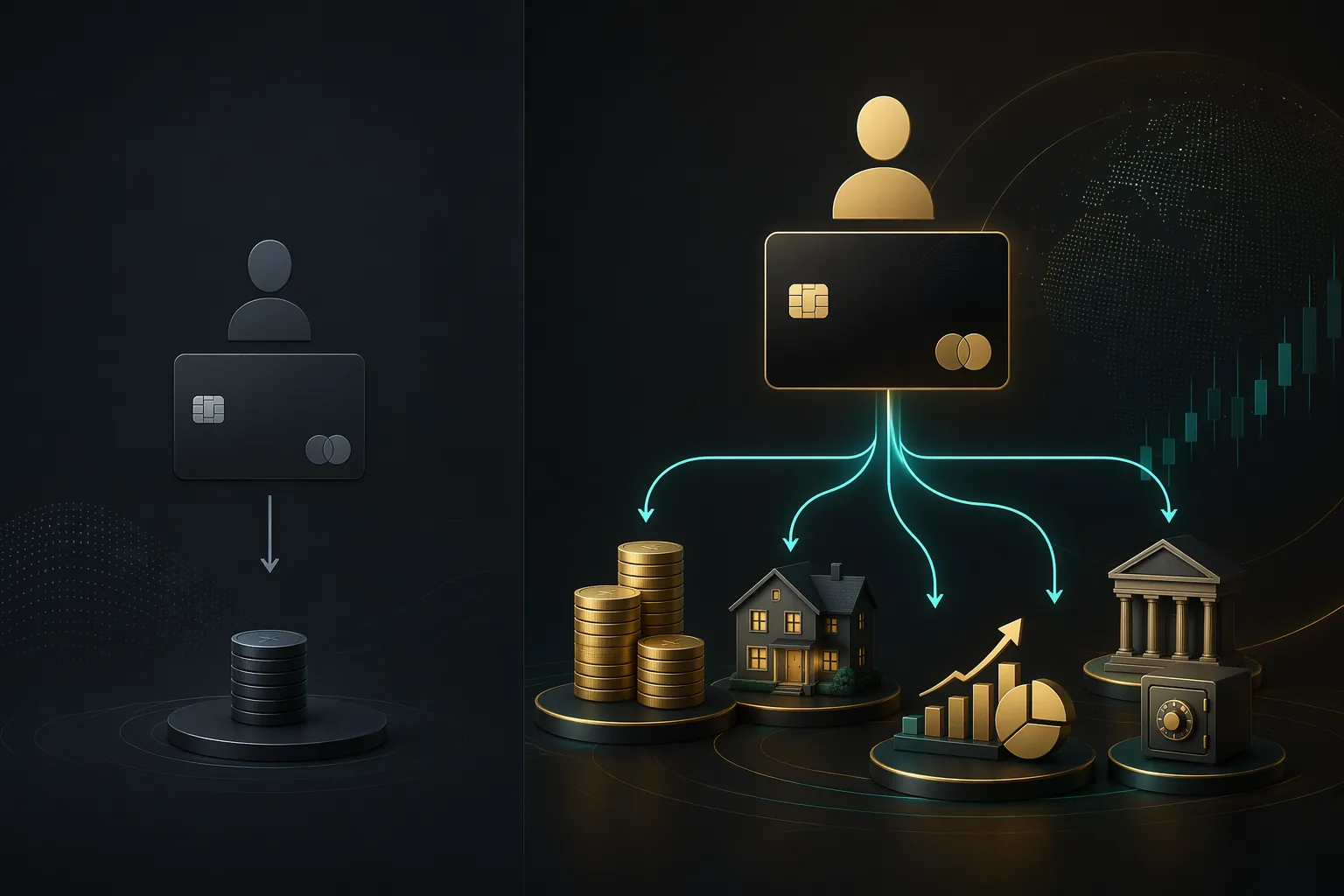
The cleanest way to read the Platinum Card is as an acquisition expense with a metal form factor. Robinhood pays, directly or indirectly, for rewards, statement credits, partner benefits, servicing, credit risk, fraud risk, and program operations. Some customers will underuse benefits. Some will optimize them aggressively. Some will revolve balances. Some will not. The card program has its own economics, but the strategic case depends on what happens after the cardholder enters the broader Robinhood environment.

In a stand-alone card model, the issuer tries to cover rewards and benefits through annual fees, interchange, interest income, breakage, merchant-funded offers, and portfolio risk management. In an ecosystem model, the card is allowed to be less elegant by itself if it brings in customers who later hold assets, fund accounts, use paid products, move deposits, adopt investment tools, or consolidate recurring financial behavior.
That distinction is not cosmetic. A cardholder who only collects 3% cash back, uses every partner benefit, pays no interest, and ignores the rest of Robinhood is a cost center. A cardholder who starts with the Platinum Card, moves cash into Robinhood Banking, holds investable assets, uses Strategies, experiments with Cortex, and stays active for years is a portfolio customer. Same card. Different P&L.
This is why historical acquisition cost matters. Sokolin’s analysis references Robinhood’s funded-account customer acquisition cost in a broad range of about $20 to $53 historically.[6] A premium card subsidy can be far higher than that and still be rational only if it is not buying an ordinary funded account. It has to buy access to a customer with meaningfully higher downstream value.
The customer journey Robinhood wants is not difficult to sketch. A user is invited to Platinum because existing behavior suggests higher value or strong fit. The card becomes a daily-spend object. Daily spend creates more app touchpoints. App touchpoints expose banking, brokerage, Strategies, and AI-assisted products. Those products create balances and recurring relationships. The card subsidy is then judged against incremental financial activity, not against the annual fee alone.
| If Platinum behaves like... | Then the economics depend on... |
|---|---|
| A stand-alone premium rewards card | Annual fee, interchange, interest income, benefit breakage, and credit performance |
| A brokerage acquisition channel | Incremental funded accounts, transferred assets, trading and advisory product usage |
| A banking acquisition channel | Deposits, cash management behavior, recurring direct relationships, and retention |
| A super-app entry point | Cross-product adoption across card, brokerage, banking, Strategies, Cortex, and future services |
This is also why the benefit stack is full of affluent-adjacent signals rather than only travel credits. WHOOP, Function Health, One Medical, and Eight Sleep do not merely pad a benefits page; they imply a customer with discretionary spend, self-optimization habits, and tolerance for subscription ecosystems.[1] The danger, of course, is that those same customers are good at extracting value. Premium users do not politely leave all the subsidy on the table.
Why Robinhood May Have A Structural Edge
Robinhood’s advantage, if it materializes, is not that it discovered premium rewards. Legacy issuers have been running that playbook for years. The more interesting advantage is control. Robinhood acquired X1 in 2023 for $95 million, giving it card-program and underwriting technology it could bring in-house rather than simply renting a generic card stack.[3]
That matters because premium card economics are shaped by small operational differences: approval criteria, line assignment, fraud controls, rewards liability, servicing cost, repayment behavior, and the speed at which card data can be fed back into segmentation. A card issuer that also owns the brokerage, banking, and product-engagement context has more surfaces for underwriting and cross-sell than an issuer seeing only a narrow credit-card relationship.
Invite-only distribution reinforces the same logic. It is launch theater, yes, and the invite-only playbook has its own scarcity mechanics. But at the portfolio level, invitation is also a risk and selection tool. Robinhood can sequence access, watch early behavior, adjust targeting, and avoid opening a high-subsidy product too broadly before it understands utilization and cross-sell performance.
The comparison to Apple Card-style ecosystem finance is useful only up to a point. Ecosystem cards work when the card increases the value of the surrounding system, not when the surrounding system is used as decoration for a rewards product. For marketers studying ecosystem credit card marketing, Robinhood is the more financially intense version of the same question: can the card make the user more valuable across the platform?
Banking Is Supporting Evidence, Not A Side Plot
Robinhood Banking gives the Platinum strategy another useful signal. Benzinga reported that Robinhood Banking crossed $1 billion in deposits from roughly 65,000 customers in four months.[7] The point is not that deposits alone validate the Platinum Card. The point is that Robinhood is already moving from single-product usage toward wallet-share capture.
Deposits change the conversation because they turn attention into balance sheet behavior. A brokerage app can have engagement without becoming a primary financial relationship. A card can have spend without producing durable loyalty. A banking product that attracts deposits suggests customers may be willing to let Robinhood sit closer to the center of their financial life.
The Platinum Card can accelerate that if it becomes the front door to a broader account structure. A premium cardholder sees cash back, benefits, balances, investment prompts, and AI-assisted tools in one environment. Robinhood’s Cortex and Strategies products belong in that same cross-sell map, alongside the company’s broader push into AI-powered financial assistance. The relevant marketing question is not whether AI makes a card sound more modern; it is whether card engagement supplies more moments to introduce higher-LTV financial products.
That is also where trust becomes more fragile. The deeper Robinhood moves into banking and AI-assisted investing, the less the brand can rely on playful brokerage-era energy. A premium card can open the door, but customers moving assets and deposits will expect reliability, underwriting discipline, support quality, and product explanations that feel proportionate to the money at stake. The company’s AI positioning, like the broader category covered in brokerage AI agent marketing, has to earn permission after acquisition.
The Risk Is Not The Fee. It Is Weak Conversion After The Fee.
A $695 annual fee makes the Platinum Card look premium, but it does not make the economics safe. Annual fees can offset benefits, yet they do not eliminate the problem of high cash-back rates, partner perks, servicing expense, acquisition cost, and adverse selection. If Robinhood attracts customers who are excellent at maximizing rewards and indifferent to the rest of the ecosystem, the card becomes a very polished subsidy machine.
The invite-only rollout reduces that risk but does not remove it. Early access can skew toward loyal users, high-asset users, or customers already more likely to adopt adjacent products. That makes launch cohorts valuable for learning, but it can also make early performance look cleaner than the economics of a broader rollout. As of Q3 2026, the Platinum Card is too new to treat utilization, retention, or cross-sell results as established.
The right scorecard is not a premium-card comparison grid. It is closer to a cohort model:
- How many Platinum cardholders were incremental to Robinhood versus already high-value customers?
- How much new brokerage asset movement follows card approval?
- How many cardholders adopt Banking, Strategies, Cortex, or other paid and balance-bearing products?
- How does benefit utilization compare with annual fee, interchange, interest income, and ecosystem revenue?
- Do Platinum cohorts retain at a higher rate than comparable non-card users after the first annual-fee cycle?
Those are less fun than counting partner benefits, but they are the questions that decide whether the card is a growth engine or an expensive loyalty trophy.
What The Benefits Are Really Buying
The Platinum Card’s benefits are doing three jobs at once. They make the annual fee psychologically easier to accept. They signal that Robinhood can package financial products for a more affluent user. And they create a reason for that user to keep returning to an app that Robinhood would rather define as a financial home than a trading utility.
The first job is familiar premium-card packaging. The second and third are where Robinhood’s marketing math gets interesting. If the company can use the card to attract customers with higher asset potential, move them into banking and investing products, and retain them through a broader suite, then the benefit stack is not merely a cost. It is a screening expense, an activation expense, and a cross-sell expense bundled into one product.
That still leaves plenty of ways for the model to disappoint. Partner benefits can be overvalued in marketing copy relative to actual customer behavior. High-income users can be expensive to serve and quick to churn if support feels thin. Legacy issuers may not be culturally beloved by every millennial professional, but they are very good at rewards liability, credit risk, travel servicing, and premium habit formation. Robinhood is entering a category where operational competence is part of the brand promise.
The strongest claim, for now, is structural rather than conclusive. Robinhood’s Platinum Card makes sense if incremental brokerage assets, banking deposits, paid-product adoption, and ecosystem retention cover the acquisition subsidy. Without that cross-sell conversion, the card is an expensive benefits bundle looking for a business model.
References
- Robinhood Platinum Card Official Product Page — Robinhood — https://robinhood.com/us/en/creditcard/platinum
- Robinhood Newsroom — Platinum Card rollout and invite strategy — Robinhood — https://robinhood.com/us/en/newsroom/robinhood-platinum-card-rollout
- Robinhood targets wealthy customers with new Platinum credit card — Reuters — 2026-03-05 — https://www.reuters.com/business/finance/robinhood-targets-wealthy-customers-with-new-platinum-credit-card-2026-03-05/
- Great Wealth Transfer: How The $90 Trillion Windfall For Millennials Could Change The Job Market And Economy — Forbes — 2024-03-01 — https://www.forbes.com/sites/jackkelly/2024/03/01/great-wealth-transfer-how-the-90-trillion-windfall-for-millennials-could-change-the-job-market-and-economy/
- Robinhood takes on premium card issuers — Payments Dive — https://www.paymentsdive.com/news/robinhood-takes-on-premium-card-issuers-amex-platinum-chase-travel/814761/
- Fintech: How can Robinhood afford 3% cash back on its new credit card? — Lex Sokolin / Substack — https://lex.substack.com/p/fintech-how-can-robinhood-afford
- Robinhood Banking Reaches $1 Billion Ahead of Platinum Card Rollout — Benzinga — https://finviz.com/news/336088/robinhood-banking-reaches-1-billion-ahead-of-platinum-card-rollout-shaping-super-app-vision
This is a record of what happened and what was tested, not legal advice. Compliance determinations require qualified counsel.