
How to Run GLM 5.3 Flash for Ad Creative
GLM-5.3-Flash is cheap enough to become an ad-creative workhorse, provided it's run the right way. This guide covers the four real hosting paths (Z.ai API, OpenRouter, Ollama Cloud, local SGLang/vLLM/llama.cpp), exact model codes and settings, per-1,000-variant costs, and where the model breaks down.
- Platform
- Z.ai API, OpenRouter, Ollama Cloud0 local SGLang/vLLM/llama.cpp
- Creative type
- AI text ad creative
- Last reviewed
- 0-08-28

Verification note — current as of August 28, 2026: GLM-5.3-Flash was released on August 26, 2026. The model is described as having 320 billion total parameters, 18 billion active parameters, a context window of up to 1,310,720 tokens through OpenRouter, and an MIT license. It accepts text, image, and video input, but its output is text only.
Choose the run path before you write the prompt
| Run path | Model identifier | Setup burden | Input and output | Pricing basis | Best operational fit |
|---|---|---|---|---|---|
| Z.ai API | Use the exact GLM-5.3-Flash identifier shown in the current Z.ai documentation or account console; do not substitute the display name for a provider ID. | Low. Create an API key, select the documented model, and send requests from a script or batch worker. | Text, image, and video input; text output. | Provider API pricing. Confirm the current rate in the Z.ai console before a production run. | A controlled async pipeline where you want a direct provider relationship and reproducible request settings. |
| OpenRouter | Use the exact GLM-5.3-Flash route identifier listed by OpenRouter. The supplied model information identifies the model but does not provide a route string to copy safely. | Low. Create an OpenRouter key and send requests through its compatible API. | Text, image, and video input; text output. OpenRouter lists a context window of 1,310,720 tokens. | Approximately $0.075 per million input tokens, based on the listed OpenRouter rate. Check output pricing separately. | The fastest API-first experiment when you want to compare routing, pricing, or availability without changing your application shape. |
| Ollama Cloud | Select GLM-5.3-Flash from the current Ollama Cloud model catalog rather than guessing a local tag. | Lower friction than self-hosting. Account access and the Ollama client are still required. | Text, image, and video input where the hosted model endpoint supports those modalities; text output. | Cloud usage terms and model availability are provider-controlled. Confirm the current account pricing before budgeting. | A low-setup on-ramp for a buyer who wants to test the workflow before managing API plumbing. |
| Local SGLang, vLLM, or llama.cpp | Use the exact published model repository and runtime-compatible identifier from the current model documentation. | High. Downloading weights is only the beginning; serving this model requires substantial multi-GPU infrastructure and runtime configuration. | Text, image, and video input support depends on the selected runtime implementation; text output remains the model boundary. | Infrastructure cost, electricity, storage, and engineering time rather than an API token price. | A team that already operates multi-GPU inference and has a reason to control serving, data movement, or throughput. |
One practical warning belongs in this table: the model name is not necessarily the model ID accepted by a provider. The supplied release information does not include safe-to-copy Z.ai, OpenRouter, Ollama, SGLang, vLLM, or llama.cpp identifiers, so an implementation should take those strings from the provider’s live documentation or console rather than inventing a plausible slug.
What 1,000 variants cost on the cheap API path
| Input tokens per variant | Input cost per 1,000 variants at $0.075/M | What is included |
|---|---|---|
| 600 | $0.045 | Input-token cost only |
| 1,200 | $0.090 | Input-token cost only |
| 2,000 | $0.150 | Input-token cost only |
The calculation is simple: variants × input tokens per variant ÷ 1,000,000 × $0.075. For example, 1,000 requests containing 1,200 input tokens each use 1.2 million input tokens, or about $0.09 at the listed rate. The number is not a complete invoice because output-token pricing is not specified, and a real request may include an image or video representation with its own token accounting.
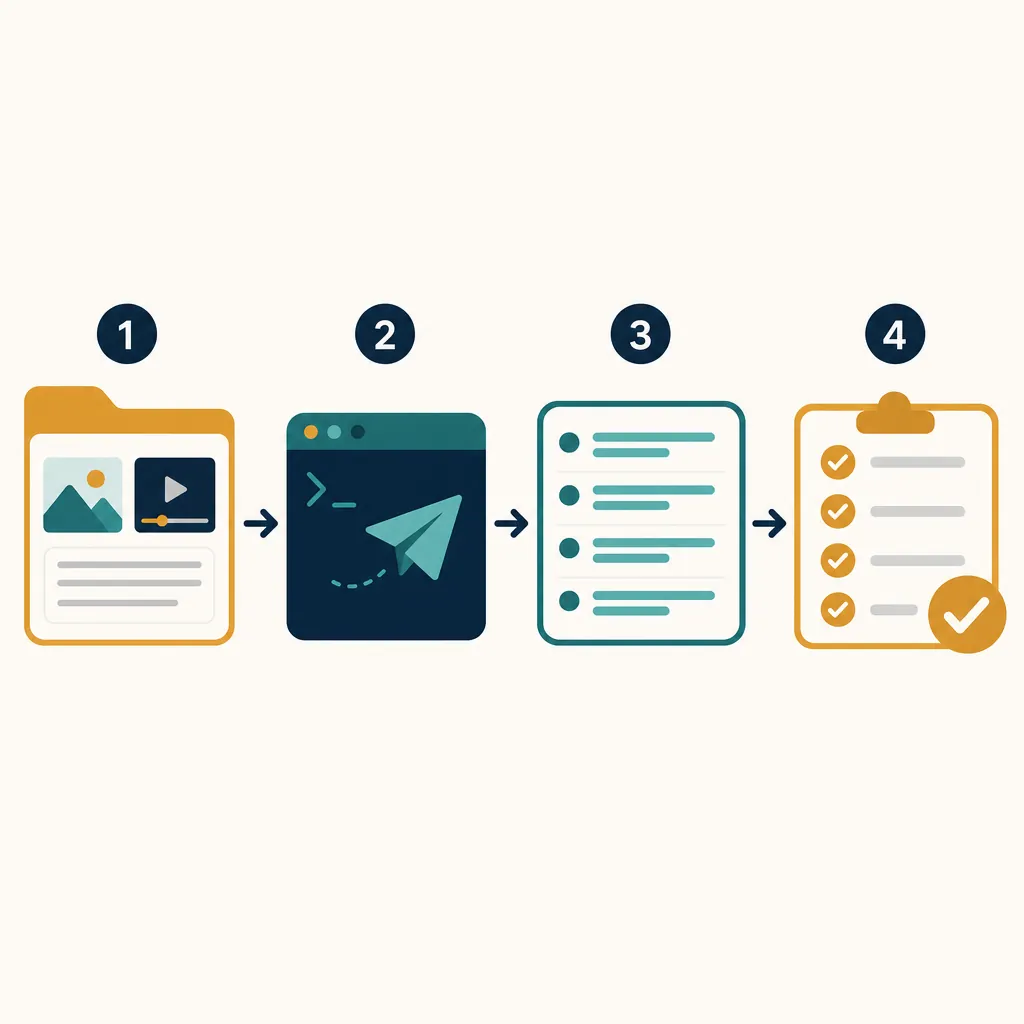
The useful workflow is asynchronous
For ad creative, the first run should be a batch worker, not a chat window. Put the source assets and task instructions into a queue, submit requests through the selected API path, save the text response beside the asset ID, and send the completed rows to a human review step. That structure makes retries possible and keeps a slow response from blocking the media buyer who needs to inspect the output.
A minimal request record should contain the creative ID, campaign or audience label, source asset location, prompt version, model identifier, generation settings, submission time, completion time, and raw response. The model can then be asked to return structured text such as variant copy, detected claims, visible text, likely objections, and a pass or review status. Store the raw response even when the parser succeeds; malformed output is much easier to diagnose when the original request is still available.
from pathlib import Path
import json
import os

# Use the exact provider values from the current provider documentation.
MODEL_ID = os.environ["GLM_MODEL_ID"]
API_KEY = os.environ["GLM_API_KEY"]

job = {
    "creative_id": "creative-001",
    "input": {
        "text": "Product brief and approved claims go here.",
        "image_or_video": str(Path("assets/creative-001"))
    },
    "task": "Return text-only ad copy variants and a visual QA report. Flag unsupported claims, unreadable text, and missing calls to action. Return valid JSON.",
    "settings": {
        "temperature": "set from the provider's documented supported range",
        "max_output_tokens": "set from the provider's documentation"
    }
}

# Submit this job with the selected provider's documented chat or batch endpoint.
# Keep the request asynchronous and persist the request and response together.
print(json.dumps({"model": MODEL_ID, "job": job}, indent=2))
The example deliberately leaves the endpoint, model ID, and numeric settings to the provider documentation. Those values are operational dependencies, not safe defaults. A script that runs with a guessed route but silently selects a different model is worse than a script that stops and asks for the correct identifier.
Z.ai and OpenRouter are the practical first tests
The direct Z.ai path is the cleanest choice when the account, model availability, and current API documentation are already in hand. It reduces routing ambiguity and gives the team one provider’s authentication, limits, pricing, and error behavior to monitor. Use it for a defined batch: for example, one product brief expanded into copy variants, or one folder of approved creatives inspected for visible text and claim problems.
OpenRouter is useful when the application already speaks a compatible API or when provider access needs to be tested without rebuilding the worker. The advertised input price is attractive for high-volume text tasks, but the budget should be calculated from the actual request shape. An image or video review is not equivalent to a short text-only prompt, and output charges must be included once the provider’s current rate is known.
For either route, begin with a small asynchronous job and inspect four things before increasing volume: whether the documented model code is accepted, whether the response matches the requested schema, whether visual inputs are actually attached and read, and whether completion time is acceptable for the queue. Cheap calls do not compensate for a review queue filled with unusable rows.
Ollama Cloud lowers the entry cost, not the modality boundary
Ollama Cloud is the reasonable on-ramp when the goal is to test the creative workflow before setting up a dedicated API worker. Select the model from the current hosted catalog, send one known asset, and verify the returned content before connecting a campaign-scale queue. The hosted path can remove much of the infrastructure work, but it does not turn GLM-5.3-Flash into an image-generation model.

Send it jobs that end in text
GLM-5.3-Flash fits tasks where the input may be visual but the deliverable is a text record. That includes producing batches of headline and body-copy variations from a brief, critiquing an existing image or video creative, extracting visible text for review, and identifying possible brand or claim violations for a person to verify.
- Batch copy variants: provide the brief, audience, offer, approved claims, prohibited claims, and required output schema.
- Creative teardowns: attach the image or video and request observations about hierarchy, visible text, offer clarity, audience fit, and possible review points.
- Visual QA: ask for a structured inventory of text, logos, calls to action, and apparent inconsistencies, then route every flagged item to human review.
These are inspection and production-support jobs, not a substitute for final creative judgment. A model-generated critique can identify what should be checked; it does not establish that a claim is legally safe, that a design will perform, or that a particular audience will respond.
The multimodal detail that changes the buying decision
“Multimodal” here means the model can inspect image and video input while producing text output. It does not mean that a prompt can return a finished ad image. If the workflow requires a new product scene, resized composition, background replacement, or final visual asset, GLM-5.3-Flash must sit beside an image-generation or design tool rather than replace it.
That distinction is easy to miss when evaluating a creative stack. A useful handoff might be: image generator or designer creates the asset, GLM-5.3-Flash checks the asset and drafts accompanying copy, and a human approves the final package. The model’s role is particularly clear when the team has more creatives to inspect than people available to inspect them manually.
Local serving is possible, but it is not a laptop install
SGLang, vLLM, and llama.cpp are the relevant local-serving families to investigate when a team already has inference infrastructure. They can provide the control that an API workflow cannot: local request handling, internal networking, serving configuration, and a path to keeping data movement within the team’s environment.
The hardware requirement is the important part. The model has roughly 321 billion parameters in the deployment estimate used for local planning, requiring about 328 GB in BF16 just for the weights. That makes local execution a multi-GPU undertaking before accounting for runtime overhead, context memory, batching, storage, networking, and operational headroom. A consumer laptop is not the expected route.
The safe local sequence is therefore: obtain the exact published model repository, confirm that the chosen runtime supports the model’s architecture and visual-input path, calculate memory for the intended context and batch size, then test a single request before exposing a service to the creative pipeline. The runtime name alone does not guarantee that every modality or serving feature is implemented.
Where the economics stop being the whole story
The low input price changes what is economically sensible. A team can preserve losing variants, request more critiques, and run larger asynchronous review batches without treating every call as precious. At the supplied OpenRouter input rate, even the illustrative 1,000-variant input calculations are measured in cents before output and visual-token charges.
Latency changes the job selection. An independent measurement found time per task to be about seven times slower than Gemini 3.7 Flash. That makes the model a poor fit for a live back-and-forth session in which a buyer changes a prompt, waits for an answer, and immediately adjusts a creative. A queue can absorb waiting; a real-time iteration loop makes the waiting visible to the person doing the work.
Before production, measure the complete task rather than only token throughput: time from submission to usable response, retry rate, schema failures, visual-input failures, reviewer corrections, and the cost of the full request. That is the comparison that matters to a media buyer inheriting the output.
The operational verdict
Run GLM-5.3-Flash through an API first, send it asynchronous batches, and make the output text that a reviewer can inspect. Its economics support high-volume copy production, creative teardowns, and visual QA from image or video inputs. OpenRouter is the clearest low-cost experiment from the listed pricing; Z.ai is the direct-provider path; Ollama Cloud is the lower-friction hosted on-ramp.
The boundary is just as useful: it is not an ad-image generator, not an instant creative copilot, and not a casual local download. Treat it as a cheap API batch worker. That classification makes the model’s strengths—capacity and low task economics—useful without hiding the latency, output, and infrastructure constraints that determine whether the workflow actually helps.
This is a record of what happened and what was tested, not legal advice. Compliance determinations require qualified counsel.