
What Dell's AI Server Growth Means for Your AI Investment Case
Dell's AI Factory has deployed over 4,000 enterprise AI systems. This article extracts practical lessons for marketing teams building AI investment cases, including real ROI data and infrastructure cost patterns.
Searches for dell stock price target 2025 ai server growth tend to pull readers toward investor coverage. The more useful signal for a marketing team is different: Dell says its AI Factory with NVIDIA has passed 4,000 enterprise deployments, and it also claims customers are seeing 2.6x first-year ROI from those deployments.[1] One number is a deployment-scale signal. The other is a vendor-sourced ROI claim. Both are useful, but they do not belong on the same slide without labels.
The 4,000-plus figure matters because enterprise AI has clearly moved beyond workshop language. Companies are buying systems, assigning workloads, and committing infrastructure budget. The 2.6x ROI figure matters because it gives budget owners a rare concrete benchmark to react against. It should not be treated as a transferable promise for a marketing automation project, a content workflow, or a private-model pilot. It is better used as a starting point for asking what would have to be true inside your own operating model for AI spend to pay back.

What Dell’s Growth Proves, and What It Does Not
Dell’s AI server growth is not just a story about one vendor catching an AI cycle. Reuters reported that Dell raised its long-term annual revenue growth forecast to 7% to 9%, up from a prior 3% to 4%, and projected earnings-per-share growth of more than 15%, citing strong AI server demand.[2] Investopedia separately reported Dell’s AI server backlog at $18.4 billion and its pipeline at more than 6,700 customers, using Dell’s own language that demand was “unprecedented.”[3]
For a marketing leader, the point is not whether Dell’s stock deserves a higher target. The point is that enterprise AI demand is showing up in harder places than keynote decks: backlog, pipeline, long-term growth targets, deployment counts, and procurement models. That changes how internal AI requests will be evaluated. A request for an AI content tool may still be a software request. A request for private data workflows, model customization, inference at scale, or governed customer intelligence increasingly touches infrastructure capacity, security review, finance policy, and IT architecture.
That distinction is easy to miss. Investor coverage asks whether AI server demand can support Dell’s growth. Marketing operations has to ask a less glamorous question: if enterprises are making infrastructure commitments, what evidence will finance expect before approving marketing’s share of AI spend?
Use the 2.6x ROI Claim as a Starting Point for Questions, Not as a Forecast
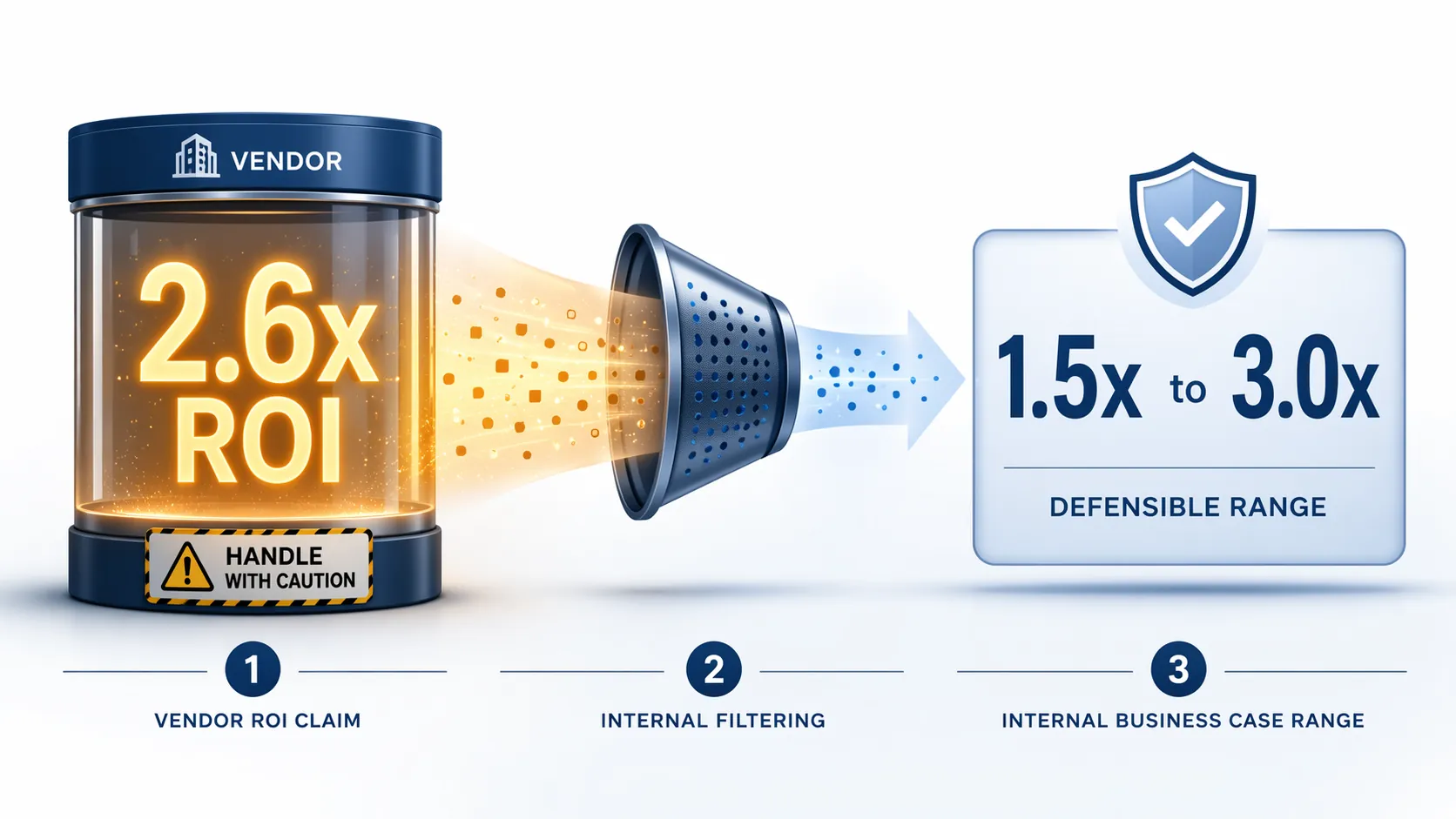
Dell’s 2.6x first-year ROI claim is the most tempting number in the story because it sounds slide-ready.[1] It is also the number most likely to get a team in trouble if it is copied into a business case without qualification. The claim comes from Dell’s own release, not from an independently audited sample of every enterprise AI deployment. It may reflect early adopters, better-prepared use cases, or customers with enough data maturity to buy infrastructure in the first place.
That does not make the figure useless. It makes it directional. A defensible internal case can cite Dell’s result as an external signal that enterprise AI deployments are producing measurable returns in some environments, then translate it into a range tied to the team’s own assumptions.
| Vendor claim | Finance-safe translation | What to test internally |
|---|---|---|
| 2.6x first-year ROI | A directional benchmark from Dell-reported AI Factory outcomes | Which costs and gains apply to your workload, data, approvals, and adoption path |
| 4,000+ enterprise deployments | Evidence that AI infrastructure buying is no longer theoretical | Whether your organization is ready for production workflows rather than pilots |
| Enterprise AI use cases across supply chain, sales, engineering, and services | Proof that ROI may come from operational redesign, not only model performance | Which marketing process has enough volume, friction, and measurable cost to justify investment |
A marketing team should separate three pieces of the ROI story before asking for money. First, the productivity gain: which task takes less time, needs fewer review cycles, or moves faster through handoff? Second, the revenue or pipeline effect: which conversion, sales enablement, segmentation, or customer-response metric might improve? Third, the infrastructure and governance cost: what must be paid for compute, data preparation, security review, legal review, integration, and change management?
The third piece is where many AI business cases get too neat. If the only costs in the model are software licenses and a few hours of training, the ROI will look artificially clean. Production AI usually creates work for teams that do not report to marketing: data engineering, security, procurement, finance, IT, and sometimes customer support or legal. Those costs do not make the investment wrong. They make the payback period real.
A More Defensible ROI Range
Instead of presenting Dell’s 2.6x figure as the expected result, build a low, base, and high case. The low case should assume slower adoption, heavier review, and lower workflow replacement. The base case should assume measured efficiency in a limited number of high-volume processes. The high case should require evidence that the AI workflow changes throughput or revenue outcomes, not just task completion time.
- Low case: AI assists work but does not remove many steps; approval and rework remain largely unchanged.
- Base case: AI reduces repeatable work in selected workflows, with human review still built into the process.
- High case: AI changes the operating rhythm, such as faster campaign localization, more complete account research, or quicker response to sales requests.
This is less exciting than dropping a 2.6x number into a deck. It is also much easier to defend when finance asks what happens if usage lags, data cleanup takes longer, or the legal team requires more review than expected.
The On-Prem Versus Cloud Question Gets Sharper at Scale
Dell’s infrastructure story also changes how teams should think about AI cost. Dell’s own analysis says on-premises AI can be 55% to 65% less expensive than public cloud at scale.[1] That is a useful scenario to test. It is not a universal rule.
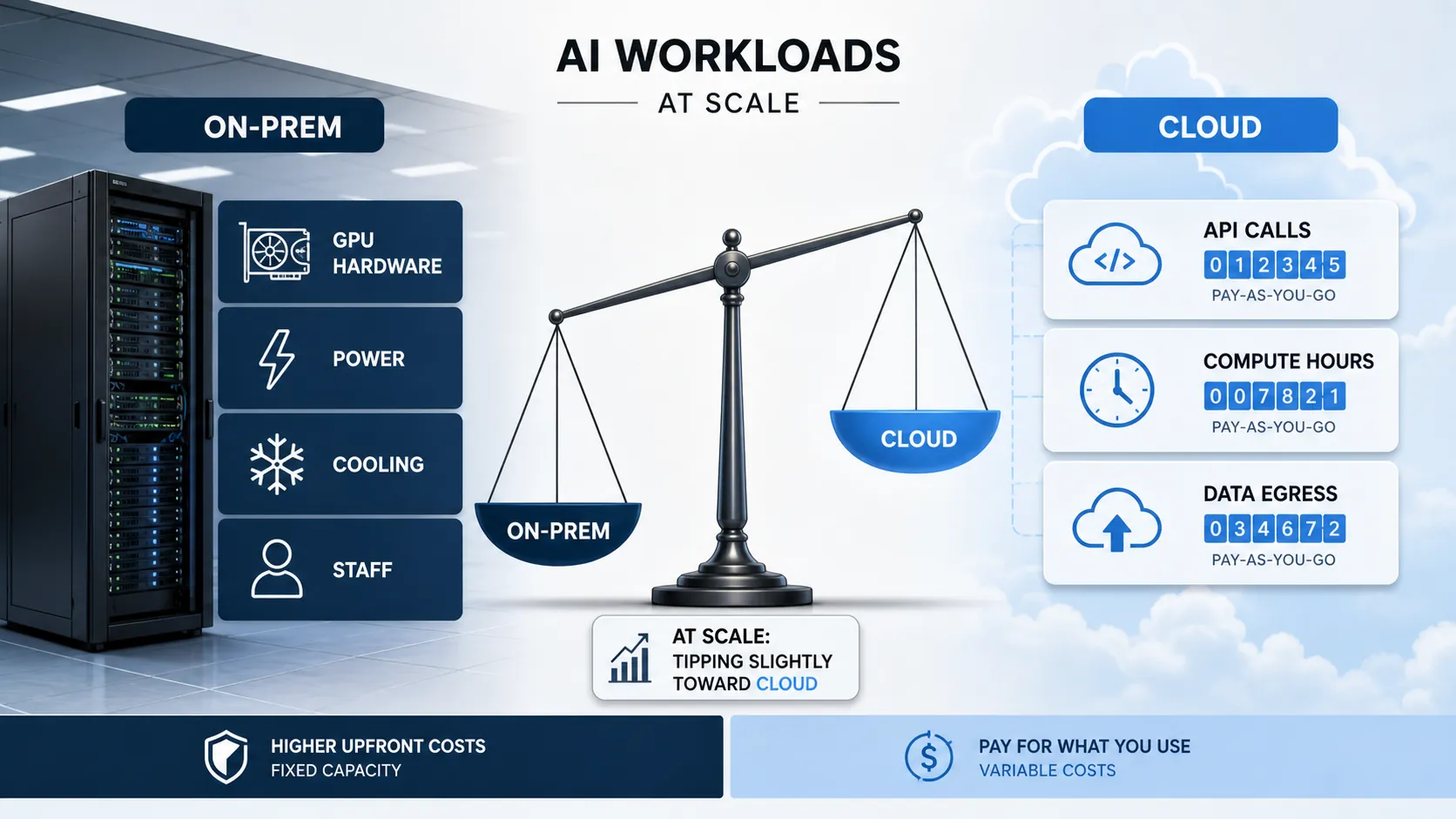
Cloud remains attractive when usage is uncertain, experimentation is still active, and the organization does not know which workloads will survive. Marketing teams often begin there for good reasons: access is fast, costs are easier to start, and vendors package AI features into tools the team already uses. The problem appears when successful pilots become always-on workflows. Metered compute, API calls, storage, data movement, and premium model access can turn a flexible experiment into a recurring cost line that grows with usage.
On-premises or dedicated infrastructure tends to enter the conversation when workloads are predictable, sensitive, high-volume, or integrated with proprietary data. That does not automatically mean marketing should advocate for owned infrastructure. It means marketing should know when its AI roadmap depends on infrastructure decisions someone else is making.
| Workload pattern | Cloud usually fits when | Dedicated or on-prem infrastructure deserves testing when |
|---|---|---|
| Early AI experimentation | Usage is uncertain and the team is still comparing workflows | Less likely, unless sensitive data or governance rules require it |
| Content and campaign operations | Volume is moderate and tools are already SaaS-based | Usage becomes high-volume, repeatable, and tightly connected to proprietary assets |
| Customer intelligence and segmentation | Data remains within approved platforms and batch usage is limited | Teams need governed access to sensitive data or frequent model inference |
| Sales enablement and account research | Outputs are assistive and usage is intermittent | The workflow becomes embedded in daily revenue operations across many users |
This is where Dell’s APEX subscription model is relevant. SiliconANGLE reported that Dell used its 2026 Dell Technologies World announcements to frame AI Factory adoption not only as a hardware purchase, but also through APEX subscription options that can shift parts of the buying discussion from upfront capital expenditure toward more flexible consumption.[4] For marketing leaders, the practical value is not the brand name. It is the procurement pattern: AI infrastructure decisions may not fit neatly into the old split between buying servers and subscribing to software.
That flexibility can help teams whose business case is strong but whose capital budget timing is wrong. It can also create a new kind of ambiguity. Subscription-style infrastructure may feel easier to approve, but it still needs workload discipline. If usage expands faster than governance or measurement, the organization has not avoided cost risk; it has changed the way the risk appears.
The 90% Not-yet-at-Scale Signal Is About Timing, Not FOMO
Dell has estimated that about 90% of enterprises have not yet deployed AI at scale.[4] The number is vendor-sourced and directional, so it should not be treated as an audited market census. Still, it helps explain why the current infrastructure wave matters. Many organizations are no longer asking whether AI belongs somewhere in the company. They are asking which workloads deserve production treatment first.
Marketing teams should read that as a timing signal. If the company is still in pilot mode, the best AI investment case may not be a sweeping transformation proposal. It may be a carefully scoped workflow with enough volume to measure and enough governance to survive review. If the company is already funding AI infrastructure, marketing has a different job: attach its use cases to the enterprise roadmap before capacity, data access, and model-support priorities are decided elsewhere.
That timing difference affects the questions leadership will ask. In a pilot environment, the questions are usually about tool choice, team training, and near-term productivity. In a scale environment, the questions become more operational: whose data is used, where inference runs, how outputs are audited, how costs are allocated, and whether the workflow creates measurable business value beyond novelty.
What Marketing Can Borrow From the AI Factory Pattern
Dell’s own examples for AI Factory deployments include areas such as supply chain, sales, engineering, and services.[1] Those are not all marketing functions, but they do share one useful trait: the use cases sit close to measurable operating work. They involve cycle time, service quality, forecasting, engineering throughput, seller productivity, or process automation. That is the level of specificity a marketing AI case needs.
A vague proposal to “use AI for content” will struggle because the value pool is too blurry. A stronger proposal names the workflow and the constraint. For example, a hypothetical marketing operations team might model AI support for campaign intake triage, not because intake sounds futuristic, but because slow intake delays creative, segmentation, approvals, and launch dates. The business case would then track what changes: fewer manual routing steps, shorter time to brief, fewer incomplete requests entering production, and less senior time spent on clarification.
The same logic applies to content operations, account research, localization, analytics requests, and sales enablement. The workload has to be narrow enough to measure but important enough to matter. If the process is rare, politically protected, or too bespoke for repeatable assistance, it may be a poor first candidate even if the demo looks impressive.
- Start with a workflow that already has volume, delay, or expensive handoffs.
- Separate tool cost from data, integration, governance, and review cost.
- Model adoption speed explicitly instead of assuming every licensed user changes behavior.
- Tie the high-case ROI to a business outcome, not only to saved hours.
- Ask IT whether the workload is likely to remain SaaS-based, move to private models, or depend on enterprise AI infrastructure.
The market context supports taking this work seriously. GM Insights projects continued expansion in the AI server market over the 2025 to 2034 period, reflecting broader demand for compute infrastructure that can support AI workloads.[5] Market sizing does not prove any single marketing use case will pay back. It does indicate that the infrastructure layer behind AI work is becoming a durable planning category, not a temporary line item attached to experimentation.
The Brake on the Growth Story
The clean version of the AI infrastructure story says demand is rising, deployments are scaling, and ROI is already visible. The messier version is the one budget owners have to live with. GPU availability can affect timing. Memory chip cost inflation can affect system economics. If component costs rise or supply tightens, vendors may have less room to discount, delivery windows may move, and internal teams may face harder prioritization.
Those constraints do not cancel Dell’s deployment signal. They make timing and workload selection more important. A marketing team that waits until enterprise AI capacity is already allocated may find itself arguing for access after higher-priority technical or operational workloads have taken the front of the line. A team that rushes in with a weak use case may win funding and still fail to show value.
The best use of Dell’s AI server growth is therefore not as a stock-market talking point and not as a borrowed ROI promise. It is a planning aid. The 4,000-plus deployments show that enterprise AI infrastructure is becoming real. The 2.6x first-year ROI claim gives teams a benchmark to interrogate. The backlog, pipeline, growth targets, subscription models, and cost scenarios show what kinds of questions finance and IT will bring into the room.
That is enough to make a stronger AI investment case. It is not enough to skip the case.
References
- Dell AI Factory with NVIDIA Delivers Proven Path to Enterprise AI ROI, Dell Technologies, Mar 2026
- Dell raises long-term annual revenue, profit growth forecasts on strong AI server demand, Reuters, Oct 7, 2025
- Dell Earnings Q1 FY2026, Investopedia
- Dell Technologies World: AI Factory, SiliconANGLE, May 12, 2026
- AI Server Market, Global Market Insights
This is a record of what happened and what was tested, not legal advice. Compliance determinations require qualified counsel.