
How deepfake AI is changing ad creative brand safety
Media buyers need to know whether AI-touched creative will get auto-labeled, rejected, or fined in 2026. This is a dated map of the platform and regulatory layers — Google, Meta, the EU, and New York — and which one hits a live account first.
- Platform
- Google Ads0 Meta Ads
- Creative type
- AI image, AI video0 synthetic performer
- Disclosure status
- Platform labels do not satisfy EU and NY legal disclosure
- Failure type
- Undisclosed AI in ad creative
- Last reviewed
- 0-08-26
If a media buyer uploads AI-touched creative in Q3 2026, the first thing most likely to hit the account is not a regulator. It is ad review: a label, a provenance signal, a self-declaration prompt, or a rejection because the platform believes the creative used generative AI without the right disclosure. Google introduced a “How this ad was made” panel in My Ad Center on July 9, 2026, across Search, YouTube, and Discover, with auto-labeling for ads made using Google’s own generative AI tools and a manual self-declare path for third-party AI tools that Google says it will not verify [1][2]. Meta’s ad help materials describe “AI info” labels for ads created or edited with generative AI tools, including auto-labels for some Meta generative tools, C2PA metadata detection for third-party tools, and undisclosed AI as a possible live-ad rejection ground [3]. Marketing Dive also covered Meta’s updated disclosure tags for AI-generated ads [4].
The regulatory layer arrives separately. The EU AI Act’s Article 50(4) applies from August 2, 2026, and legal analyses describe penalty exposure up to €15 million or 3% of worldwide annual turnover for certain violations, with “deep fake” guidance broad enough to cover realistic AI-generated or manipulated people, objects, places, and avatars rather than only face-swaps [5][6]. New York’s A8887-B synthetic-performer rule became effective June 9, 2026, with reported penalties of $5,000 to $10,000 per violation for ads using AI-generated digital replicas of recognizable performers [7].
That split is the practical answer behind the deepfake AI impact on ad creative brand safety: platform review controls whether the ad runs cleanly today; law controls whether the disclosure and rights position can survive outside the platform. One does not substitute for the other. If you want the longer version of that compliance gap, the site has a separate deep dive on why platform AI labels don’t make synthetic ads compliant. This piece stays with the dated operating map: what gets labeled, rejected, logged, or escalated before launch.

Deepfake risk is not the same thing as every AI edit
The word “deepfake” still drags malicious impersonation into the room: scam ads, fake endorsements, political manipulation, and synthetic footage presented as real. Those are not the same operational category as a lawful product ad that used a generated background, a synthetic lifestyle scene, or an avatar actor approved through a client workflow. Treating them as one bucket makes the upload queue worse, not safer.
For paid-social and search teams, the useful classification is not “AI or no AI.” It is what kind of asset could trigger platform labeling, identity review, legal disclosure, or rights clearance. A photoreal synthetic person is different from a color-balanced product shot. A recognizable performer replica is different from an invented avatar. A generated city street behind a product may matter under the EU’s broad deep-fake framing even when no human face appears [5].
| Creative asset | Why it matters before upload | Likely review or disclosure pressure |
|---|---|---|
| Photoreal synthetic person or avatar | Can be read by viewers as a real person or scene; may fall within broader deep-fake disclosure concepts in the EU. | Platform AI labels; EU disclosure review; provenance log. |
| Recognizable performer replica | Raises identity, performer, and consent questions even if the ad is not malicious. | New York synthetic-performer review; client legal approval; platform policy review. |
| Voice clone or synthetic voice resembling a real person | Often becomes an identity/replica issue rather than a simple production shortcut. | Rights clearance and disclosure review before trafficking. |
| AI-generated or AI-edited video/image using platform tools | May trigger auto-labeling when built inside Google or Meta generative ad tools. | Google or Meta label mechanics; upload log entry. |
| Third-party AI-generated image or video | May carry C2PA or other provenance metadata; may require self-declaration depending on platform mechanics. | Meta C2PA detection; Google self-declare path; preflight metadata check. |
| Lighter cosmetic edit | May not carry the same disclosure load, but it still needs to be logged if a generative tool changed the asset. | Internal asset history; case-by-case platform and legal review. |
The 2026 enforcement map for live accounts
The order matters. A regulator may be the bigger long-tail risk, but a platform decision is what pauses spend, delays launch, or forces the trafficker to explain why a winning creative now carries a label the client did not approve. The current map looks like this:
| Layer | 2026 date or status | What changed | What it does not solve |
|---|---|---|---|
| Google Ads | July 9, 2026 launch; July 2026 policy update | “How this ad was made” disclosure in My Ad Center across Search, YouTube, and Discover; auto-labeling for ads made with Google’s own generative AI tools; manual self-declaration for third-party AI tools that Google says it will not verify [1][2]. | Does not prove legal compliance, consent, or EU/New York disclosure sufficiency. |
| Meta ads | Current 2026 help-center mechanics should be rechecked before launch | “AI info” labels for ads created or edited with generative AI tools; auto-labels for Meta Background Generation, Image Generation, and Add Animation; C2PA metadata use for third-party tools; undisclosed AI can be a rejection ground [3][4]. | Does not replace a rights log or jurisdiction-specific disclosure review. |
| EU AI Act | Article 50(4) applies August 2, 2026 | Deep-fake disclosure obligations apply to a broad category of realistic AI-generated or manipulated content, with potential fines described up to €15 million or 3% of worldwide annual turnover [5][6]. | Does not guarantee Google or Meta approval, and the consumer-facing label format was still unsettled in the cited July 2026 guidance. |
| New York synthetic-performer rule | Effective June 9, 2026 | A8887-B targets ads using AI-generated digital replicas of recognizable performers, with reported penalties of $5,000 to $10,000 per violation [7]. | Does not answer whether the platform will label, reject, or limit the ad. |
| California | No specific 2026 upload-triggering change is established in the cited record here | Keep California-facing synthetic-person campaigns in legal review, especially when identity, likeness, or replica questions are present. | Do not invent a platform checklist item unless a sourced California obligation actually applies. |
Google’s label is useful, but it is narrow
Google’s July 2026 change is easiest to misunderstand because it looks clean inside the product. The “How this ad was made” panel appears in My Ad Center and tells users when an ad was made using Google’s generative AI tools. That matters for account operations because it creates a visible consumer-facing artifact attached to the ad, not just an internal note in the creative brief [1].
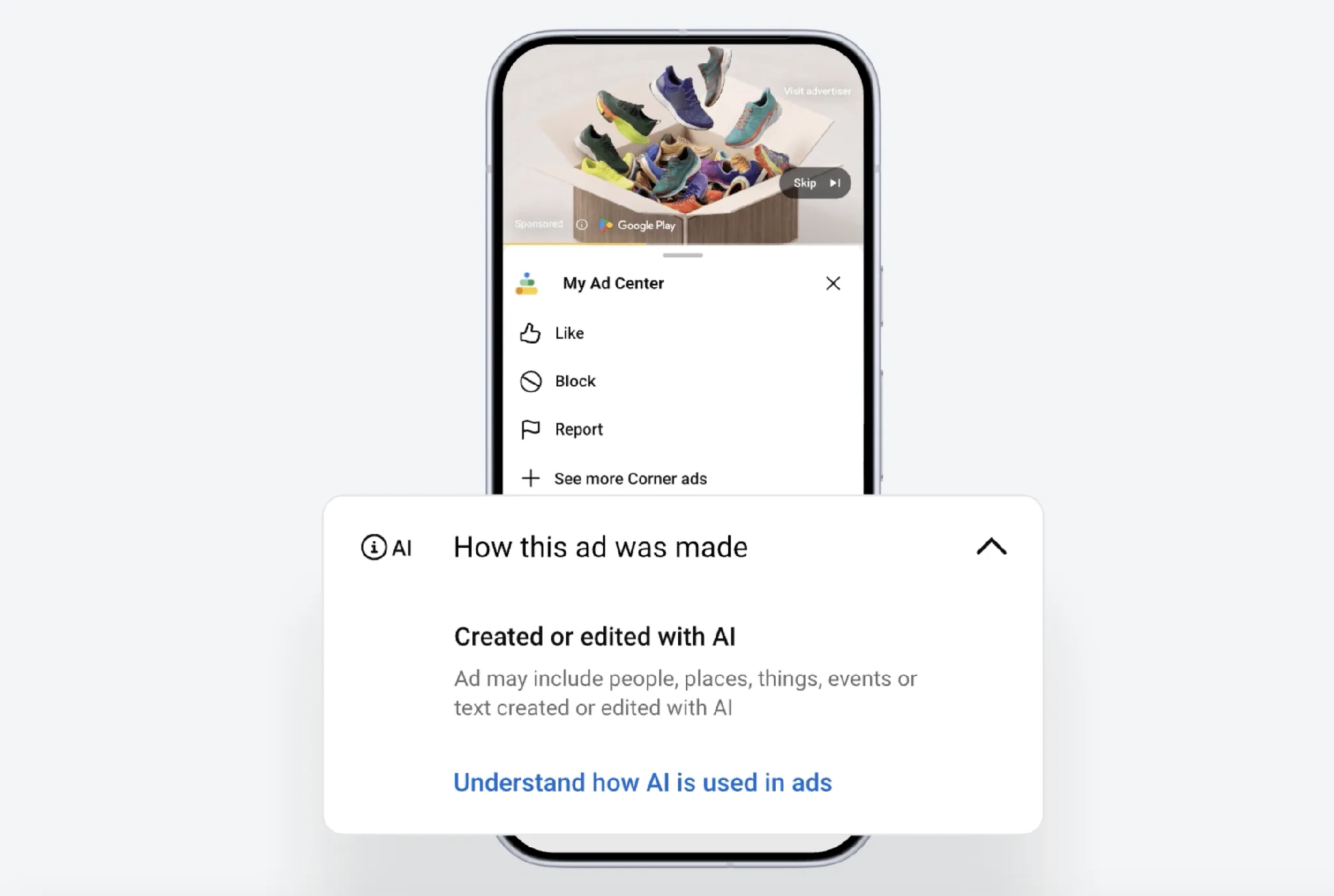
The important boundary is that Google’s automatic labeling is tied to ads made with Google’s own generative AI tools. For third-party AI tools, Google’s policy update describes a manual self-declaration control and says Google will not verify that self-declaration [2]. That is not a small footnote. It means a team cannot treat Google’s label state as a complete asset-history record. If an agency built a hero image in one tool, extended the background in another, and then assembled the final in a standard editor, the media buyer still needs a handoff record. Google’s interface may not reconstruct that chain for them.
Meta brings the issue closer to rejection mechanics
Meta’s 2026 mechanics are more uncomfortable for trafficking teams because the help material connects AI disclosure to live-ad review. Meta says ads created or edited with generative AI tools can show “AI info,” and it describes auto-labeling when advertisers use Meta’s Background Generation, Image Generation, or Add Animation tools [3]. Marketing Dive’s coverage of the updated tags shows the same direction: AI disclosure is moving into the ad surface, not staying inside an ethics deck [4].
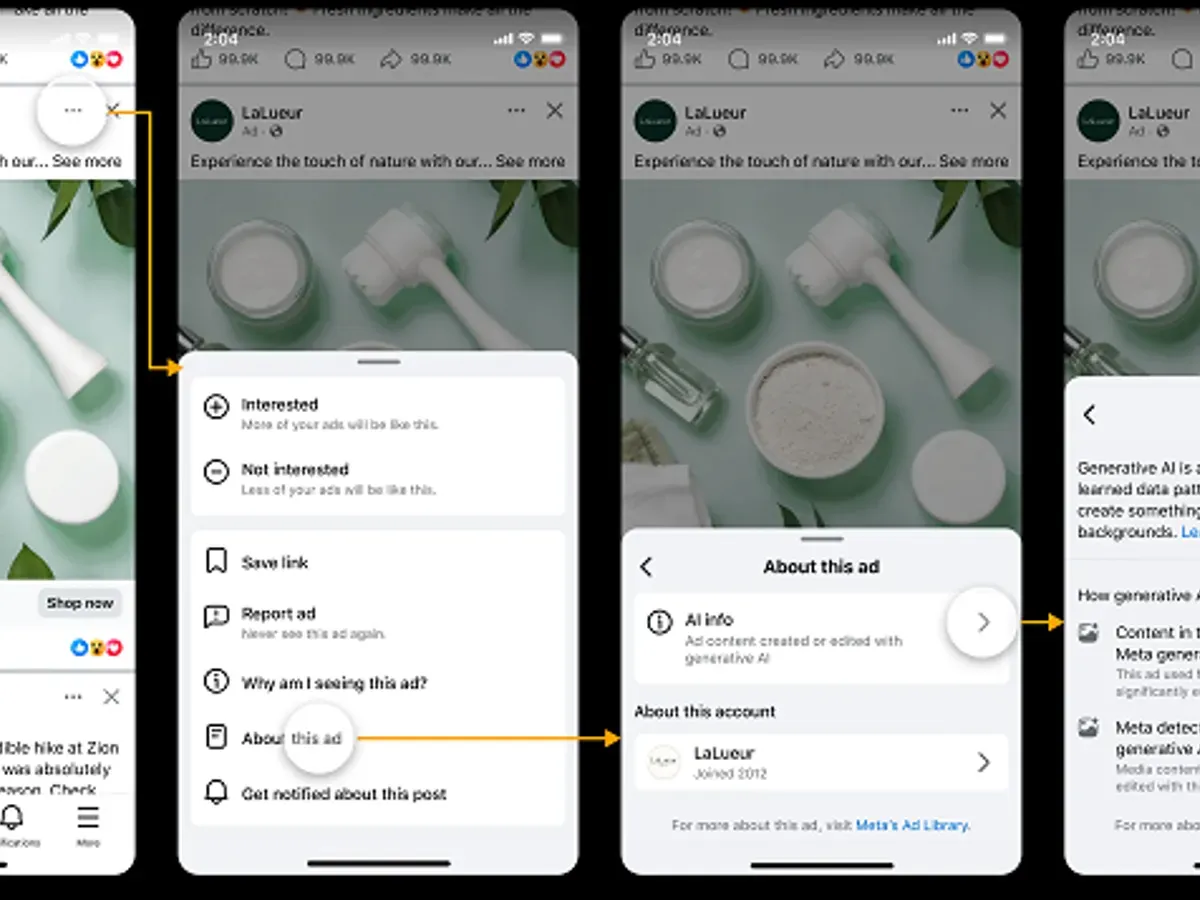
Meta also says it uses C2PA metadata to help detect ads made with third-party generative AI tools [3]. That is where brand safety stops being an abstract policy question and becomes a file-handling question. Did the export strip metadata? Did the creator use a tool that writes provenance metadata? Did the editor composite generated and non-generated elements into a new file? If the answer is “nobody knows,” the buyer is left guessing at the exact point where the account needs certainty.
For a deeper treatment of the detection side — including why C2PA and AI-video detection are useful but not magic — see Can You Trust AI Video Detection for Paid Ad Brand Safety? The operational point here is simpler: if Meta can label or reject based on AI disclosure mechanics, then creative operations needs an asset-level record before upload, not after a rejected ad appears in the account.
The EU changes the meaning of “deepfake” for advertisers
US marketing teams often hear “deepfake” and think of a celebrity face swap. The EU materials are broader. Legal analyses of the EU AI Act’s Article 50(4) describe a deep-fake disclosure obligation applying from August 2, 2026, and note that the Commission’s framing can reach realistic AI-generated or manipulated depictions of objects, places, entities, events, and avatars, not only a person’s face [5][6].
That matters for ad creative because a generated destination, showroom, medical setting, workplace, or testimonial environment may create disclosure questions even when no famous person appears. A synthetic spokesperson can be lower-risk than an unauthorized celebrity replica and still be realistic enough to need review. The EU layer is not just a scam-ad layer; it is a realism and disclosure layer.
The awkward part in Q3 2026 is that the consumer-facing label format was still not fully settled in the cited guidance, and it remains an open question whether platform labels from Google or Meta will align with whatever EU-facing standard becomes expected [5]. That uncertainty should not freeze campaigns. It should prevent anyone from writing “Meta labeled it” in the approval notes and calling the EU question closed.
New York is about recognizable performers, not generic AI backgrounds
New York’s 2026 rule is narrower than the EU issue but sharper when it applies. A8887-B, effective June 9, 2026, is described as applying to ads using AI-generated digital replicas of recognizable performers, with penalties of $5,000 to $10,000 per violation [7]. That points directly at a common creative-ops failure: the team knows an avatar or synthetic performer was used, but the final approval packet does not say whether the likeness is fictional, licensed, or recognizably based on someone.
A generic generated model in a product shot is not the same risk tier as a digital replica of a recognizable performer. A client-approved synthetic spokesperson is not the same as a lookalike intended to evoke a real actor. A voice, face, body, or performance style that makes the legal team ask “who is this supposed to be?” should not arrive at the media buyer’s desk as a flattened MP4 with no notes.
Two independent layers means two separate approvals
Agency-facing guidance has framed AI ad disclosure as two independent layers: platform disclosure and legal disclosure [8]. That is the cleanest way to run the queue. Platform approval asks whether the ad satisfies Google, Meta, or another network’s submission rules. Legal approval asks whether the ad satisfies jurisdictional disclosure duties, likeness rights, performer rules, and client risk tolerance. The same file can pass one and fail the other.
The IAB’s AI Transparency and Disclosure Framework is useful as a provenance vocabulary and industry reference point, but it should not be treated as a substitute for checking the current platform requirement or the current legal disclosure obligation. The versioning question around the framework should be confirmed before teams cite a specific version in client policy language [9].
What to log before the ad ever reaches review
The fix is not to ban synthetic creative. It is to stop accepting untraceable assets. A paid team can move fast with AI video variants and still keep a clean account if the handoff record travels with the file.
- Inventory every AI tool used on the asset. Separate platform-native tools from third-party tools because Google and Meta treat those paths differently.
- Require creators and editors to disclose AI use before handoff. The media buyer should not be discovering generative edits during rejection troubleshooting.
- Keep a per-asset decision log. At minimum, record whether the asset contains a photoreal synthetic person, recognizable performer replica, voice clone, AI-generated background, AI-generated object/place, or only lighter edits.
- Inspect provenance where possible. Preserve C2PA or other metadata when it exists, and document when exports, edits, or resizing may have removed it.
- Check likely platform labels before launch. If Google or Meta may surface an AI disclosure, the client should approve the labeled-ad experience before spend goes live.
- Route EU and New York questions separately from platform review. A platform label is not a legal disclosure memo; a legal disclosure is not a guarantee that Meta or Google will approve the ad.
- Keep the approval chain attached to the final creative ID. When a winning variant is paused, the person in the account needs the actual asset history, not a Slack memory.
| Log field | Useful entry |
|---|---|
| AI tools used | Tool name, platform-native or third-party, and whether it generated, edited, extended, animated, or voiced the asset. |
| Synthetic people | None, fictional avatar, photoreal synthetic person, or recognizable performer replica. |
| Voice and performance | Human-recorded, synthetic voice, voice clone, or unclear. |
| Scene realism | Real location, generated location, generated object/place, composited scene, or cosmetic-only edit. |
| Provenance status | C2PA present, metadata stripped, no metadata available, or not checked. |
| Platform expectation | Likely Google label, likely Meta AI info label, self-declaration needed, or legal review before upload. |
| Jurisdiction review | EU disclosure review, New York performer review, other legal route, or not applicable based on campaign targeting. |
The unresolved items are real: the EU consumer-facing label format was still unsettled in the cited 2026 materials, platform alignment with EU expectations remains open, Meta’s help-center mechanics should be rechecked at launch time, and IAB framework versioning should be confirmed before it is written into client policy. None of that changes the operating state for 2026. Deepfake AI is changing ad creative brand safety by making provenance and disclosure part of creative operations. It is not making every synthetic asset unusable.
References
- Google introduces new AI labels for Ads — Google, July 9, 2026
- Updates to AI labeling requirements (July 2026) — Google Advertising Policies Help, July 2026
- About AI info on ads created or edited with generative AI tools — Meta Business Help Center
- Meta adds updated disclosure tags for AI-generated ads — Marketing Dive
- EU AI Act Guidance Expands AI Disclosure Rules for Advertisers and PR Teams — Davis+Gilbert
- AI-Generated Advertising: When Is Disclosure Required and When Is It Not Enough? — Loeb & Loeb
- FTC AI Disclosure Rules 2026: Complete Marketer Guide — theStacc
- The AI Ad Disclosure Deadline Every Agency Needs to Know About Before Clients Do — Adriel
- AI Transparency and Disclosure Framework — IAB
This is a record of what happened and what was tested, not legal advice. Compliance determinations require qualified counsel.