
What the CeraVe Phuwin brand events did and didn't measure
CeraVe Thailand ran three Phuwin brand events in 2026. This dated case file separates what a media buyer can verify — event dates, purchase-gated mechanics, retailer pricing — from the zero published performance data, showing why the receipt-based gate measures volume, not incrementality.
- Platform
- TikTok Live
- Creative type
- influencer live commerce
- Last reviewed
- 0-08-25
The checkable record starts with three dates
CeraVe Thailand ran three public Phuwin-linked brand activations in 2026. The record supports the dates, venues, access mechanics, retailer pricing, and fan-coordinated trend pushes. It does not support a performance claim. As of August 25, 2026, the public materials located for this case do not publish Thailand-side sales lift, GMV, conversion rate, livestream view count, incremental buyers, retailer redemption totals, or engagement results for the three-event run [1][2][3][4].
| Date | Activation | Publicly visible mechanic | What it can verify |
|---|---|---|---|
| Feb. 28, 2026 | CeraVe Acne Buster Live on TikTok Live, scheduled for 12:00 TH | Fan trend push scheduled from 11:30 before the livestream | A dated livestream activation and coordinated fan mobilization, not published livestream performance [1][5][6] |
| Apr. 27, 2026 | CeraVe Blemish meet-and-greet at Park Silom, 11:00 TH | ฿1,099+ receipt gate for raffle entry, 30 winners, plus a top-spender access route | A purchase-gated event system tied to retail receipts, not proof of incremental demand [2] |
| Aug. 25, 2026 | CeraVe Glow Lab brightening-cleanser launch with Phuwin and Permpoon at Parkside, G Floor, Dusit Central Park, 15:00 GMT+7 | Public event announcement and logistics, with hashtag activity around #CeraVeGlowLabxPhuwin | A third repeated celebrity-event beat, not published launch performance [3][4] |
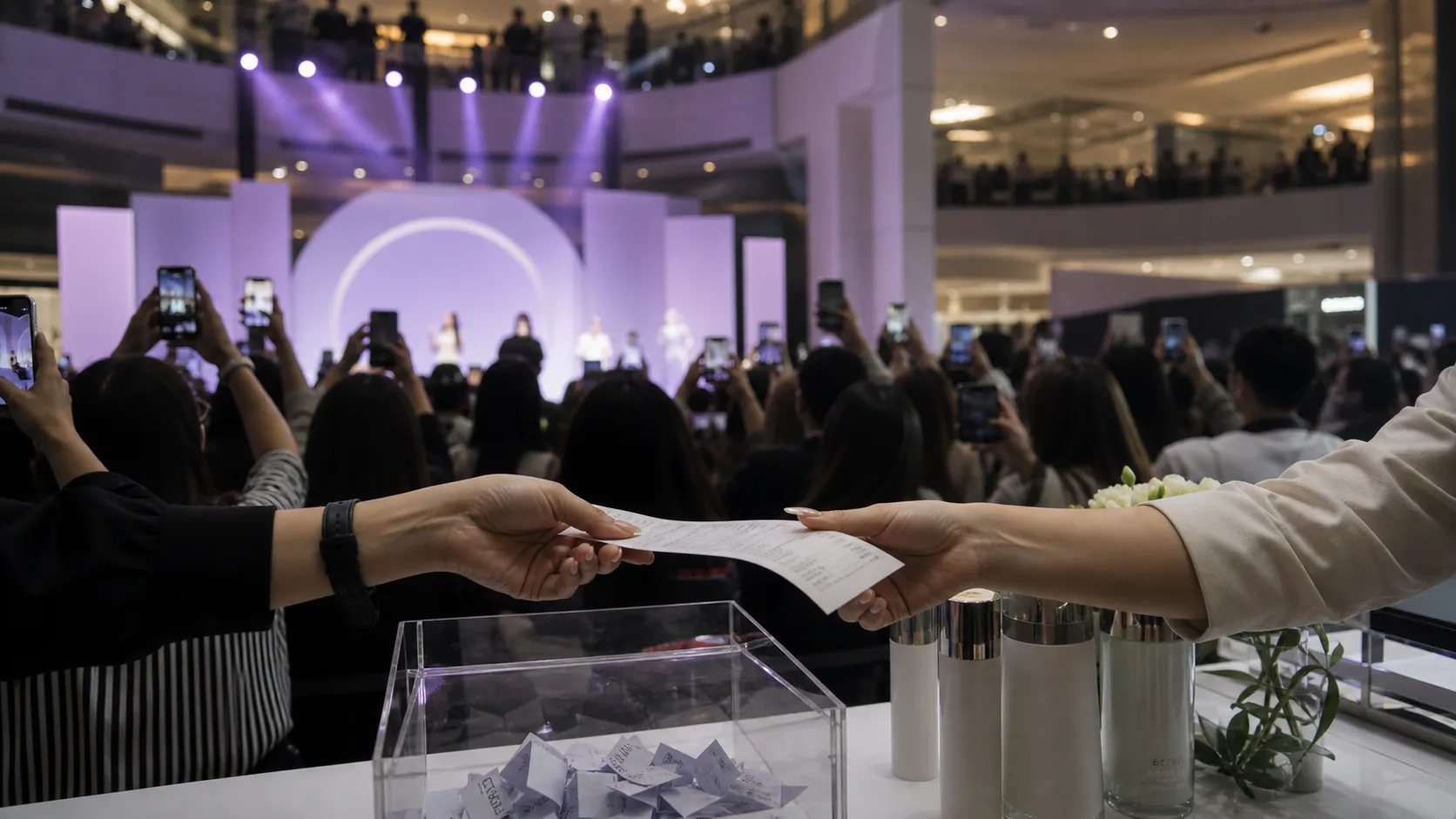
That sequence is the important part. This was not a one-off celebrity appearance that happened to get noisy online. It was a repeatable playbook: schedule the talent moment, give fans a trend window, route purchases through retailers, and use event access as the prize. For a media buyer, that is more useful than a mood reel because it shows what the campaign was built to capture.
The strongest version of the case is not “Phuwin fans made CeraVe trend.” Fans can do that when they are organized, motivated, and given a clean tag. The stronger case is that CeraVe Thailand put commercial gates around the attention. The April event, in particular, moved beyond passive awareness: a buyer needed a qualifying receipt before the meet-and-greet system would count them for access [2].
The receipt gate is the campaign’s real measurement layer
The April 27 Park Silom mechanic is the cleanest measurement object in the run. The public post set a ฿1,099+ receipt threshold for raffle participation and offered 30 winner slots. It also sat alongside a top-spender route, which is a different incentive: instead of giving every qualifying buyer one chance, it rewards the highest purchase value in the window [2].
Those two gates measure different behaviors. The raffle threshold encourages enough people to cross a minimum basket value. The top-spender route pushes a smaller number of fans to increase basket size. Neither mechanic is vague. Both can produce a transaction file if the retailer and brand reconcile receipts properly: date, store or platform, SKU mix, basket total, promotion applied, and whether the buyer entered the event system.
Watsons gives the clearest public retail layer because its co-branded “CeraVe X Phuwin” page preserved the shopping environment around the activation. As captured for this case, the page showed event-window pricing examples including Blemish Control Cleanser 88ml at ฿275 versus ฿290, Blemish Control Cleanser 473ml at ฿788 versus ฿830, and Resurfacing Retinol Serum at ฿755 versus ฿799 [7].

That page matters because it ties the celebrity event back to a retail shelf. If the only artifact were a fan hashtag, there would be little to audit beyond reach and posting volume. With a retailer page, discounted products, and receipt-based eligibility, the campaign becomes reconstructable. A planner can ask which SKUs moved, which retailer captured the sale, whether the basket crossed the threshold because of the event, and whether the buyer entered the raffle.
Konvy and Boots appear in the broader retail layer of the campaign record, with Konvy identified through a shop-to-win access mechanic. The public evidence available here is less price-specific than the Watsons page, so it should not be treated as equivalent SKU-level documentation. The useful point is narrower: CeraVe Thailand did not leave the Phuwin attention floating in social media. It connected attention to shopping paths and event access.
What receipts can prove, and what they cannot
A receipt gate can prove that someone bought during the qualifying window. It can show transaction volume attached to the promotion rules. If the brand and retailer share enough data, it can also show basket size, product mix, store split, and the number of buyers who tried to convert purchases into event access.
It cannot, by itself, prove that Phuwin created new demand. A fan who already planned to buy cleanser could time the purchase for the event window. A regular CeraVe user could add one extra item to clear the ฿1,099 gate. A discount could pull forward a purchase that would otherwise have happened the next week. A top-spender race could concentrate sales among existing high-intent fans rather than expand the buyer base.
| Claim someone might make | What the public record supports | What would still be needed |
|---|---|---|
| The campaign drove purchases | Qualifying receipts and retailer shopping pages show the campaign was designed to capture purchases | Total dated sales, redemption count, SKU sell-through, and comparison to a pre-event baseline |
| Phuwin brought in new buyers | The public materials show Phuwin was the event draw | New-versus-returning buyer data, first-purchase share, CRM matchback, or retailer buyer segmentation |
| The event increased sales beyond normal demand | The mechanics can record campaign-window volume | Holdout markets, matched stores, pre/post baseline, or another incrementality design |
| Trending proved market demand | Fan posts show coordinated mobilization around hashtags | Organic share, non-fan participation, paid-versus-earned split, and downstream conversion evidence |
This is where a lot of recap decks overreach. “Sold out energy” is not the same as sell-through. A long receipt line is not the same as incremental revenue. A purchase gate is valuable, but it measures what happened inside the gate. Without the counterfactual, it cannot say what would have happened without the celebrity incentive.
Fan trend schedules belong in the file, not in the results column
The February Acne Buster Live had a scheduled trend push before the 12:00 TH livestream, with fan accounts posting coordinated timing and hashtag instructions around #CeraVeAcnexPhuwin [5][6]. The later campaign trail followed the same pattern with #CeraVeBlemishxPhuwin and #CeraVeGlowLabxPhuwin attached to the April and August beats [2][3].
That is evidence of mobilization. It is not automatically evidence of organic demand. Thai fan clubs are very good at timing, tagging, boosting, and making a campaign feel bigger than the venue. That labor has marketing value. It can widen visibility, improve launch atmosphere, and give the brand more social surface area to retarget. It still needs to be separated from buyer behavior.
The distinction matters because the fan activity and the retail mechanic can point in different directions. A campaign can trend and under-sell. It can sell through a gated promotion without broad organic conversation. It can also do both, but the public record has to show both before the claim is safe.
The Thailand data gap is more noticeable because the category can measure
Thailand is not a market where live commerce and creator-led selling are theoretical. Nation Thailand reported that Janey’s TikTok live session reached a record 100 million baht in October 2025, while also citing DAAT 2025 seminar commentary that roughly 60% of brands run influencer campaigns without understanding ROI. The same report noted familiar live-commerce caveats behind headline GMV, including order cancellations, abandoned carts, and cash-on-delivery non-conversion [8].
That context puts pressure on the CeraVe Phuwin case. The campaign used live, social, and retail mechanics in a market already trained to treat creator activity as commerce. If a brand wants the event to be judged as performance marketing, the missing pieces are not exotic. They are the normal pieces: confirmed orders, completed payments, retailer sell-through, cancellation-adjusted sales, buyer type, and baseline.
CeraVe also has a global precedent for publishing outcomes when it chooses. The brand’s “Cleanse Like a Derm” global TikTok Live event was described by Coyne PR as drawing 5,000+ virtual viewers from 62 countries, and Campaign US reported a 52% week-over-week lift in core-cleanser sales tied to the effort [9][10].
The point is not that the Thailand activation needed to match those results. Different markets, mechanics, retail partners, and media plans should not be flattened into one benchmark. The point is simpler: outcome reporting is possible. For the Phuwin run, the public record stops before that layer.
The buying judgment
The CeraVe Phuwin brand event run should be classified as a well-structured purchase-gated retail promotion with influencer heat around it. That is not a small thing. The mechanics were more commercially literate than a pure photo-op: they created receipt thresholds, retailer pages, discount windows, raffle access, and top-spender incentives.
It should not be classified, from the public evidence available, as a measurable influencer-performance case. The visible gate measures campaign-window volume. It does not publish incrementality. It does not show whether Phuwin changed the buyer mix. It does not show whether discounted demand was new, pulled forward, or shifted from another CeraVe channel.
Before funding a copycat activation, ask for five things in writing: dated sales, baseline, redemption, buyer, and incrementality evidence. Dated sales show what moved and when. Baseline shows what would have been normal. Redemption shows how many purchases actually entered the event system. Buyer evidence shows whether the campaign acquired new customers or concentrated existing fans. Incrementality evidence shows whether the celebrity mechanic changed the outcome beyond what price, distribution, and existing demand would have done anyway.
Without those, the safe claim is narrow: CeraVe Thailand built a repeatable Phuwin-led retail activation that could capture transactions. The public record does not show that it created incremental demand.
References
- CeraVe Acne Buster Live schedule, Instagram
- CeraVe Blemish ฿1,099 receipt-gate and 30-winner mechanic post, Instagram
- CeraVe Glow Lab post with Phuwin and Permpoon, CeraVe Thailand Official on Facebook
- CeraVe Glow Lab logistics corroboration, Sina News
- CeraVe Acne x Phuwin fan trend-schedule post, PHUWIN BOOST HUB on X
- CeraVe Acne x Phuwin fan trend post, PhuwinOfficial on X
- CeraVe X Phuwin, Watsons Thailand
- TikTok live commerce takes off in Thailand as brands seek measurable ROI, Nation Thailand
- CeraVe Global TikTok Live Event, Coyne PR
- CeraVe global TikTok Live event leads to increase in sales, Campaign US
This is a record of what happened and what was tested, not legal advice. Compliance determinations require qualified counsel.