
Callaway's ad approval failure is a brand safety lesson
The August 2026 Good Good x Callaway driver ad got Callaway's approval — then Callaway disavowed it. This dated post-mortem shows media buyers why approval is not contextual review, and what to change in creator-collab approval workflows, post-launch monitoring, and contract terms.
- Platform
- YouTube
- Creative type
- video
- Failure type
- approval-chain failure
- Last reviewed
- 0-08-28
On August 25, Callaway CEO Chip Brewer acknowledged the fact that turns this episode from a bad creator concept into an approval-chain failure: the video “was produced by Good Good, but it was approved by Callaway prior to posting.” He immediately added, “That approval should never have happened.”[1][2] The Good Good Golf–Callaway ad controversy is therefore not a case in which a brand first encountered objectionable partner content along with the public. Callaway had already said yes.
| Incident record | Status |
|---|---|
| Last reviewed | August 28, 2026 |
| Public incident window covered | August 21–25, 2026 |
| Current outcome | Interim; investigations and partner decisions remain unresolved |
| Central control failure | Callaway approved the video before publication, then publicly said that approval should never have happened |
That contradiction matters more than an argument over whether the concept was edgy, tasteless, or self-evidently unacceptable. The people exposed to the threatening behavior in the ad experienced the result, not the internal intent. The operator handling the fallout then had to remove placements, notify stakeholders, preserve evidence, and protect partner relationships. An approval chain offers little demonstrable protection when the public record cannot establish who reviewed the final asset, which context they saw, and what authority their approval represented.
The incident moved from publication to partner escalation in four days
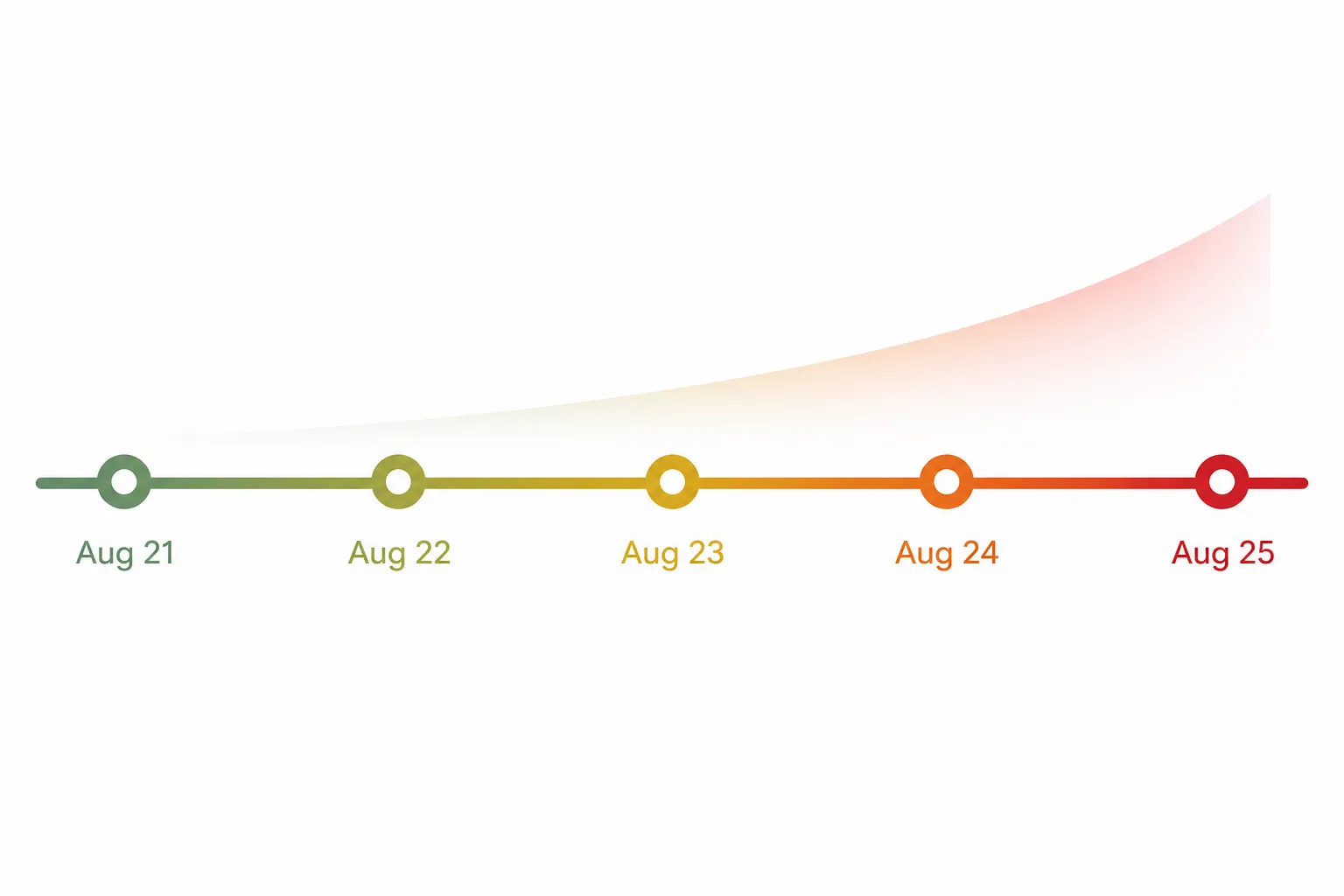
The chronology is the useful part of this brand-safety lesson. It connects the original sign-off to public exposure, deletion, commercial remediation, and institutional response rather than treating each as an isolated news update.
| Date | What happened | What changed operationally |
|---|---|---|
| August 21 | Good Good published a co-branded ad for the Quantum driver. The video showed co-founder Garrett Clark shoving creator Alexis Miestowski to the ground, followed by the line, “Do not touch my new driver.”[1][2] | An approved asset became a public brand exposure. |
| August 22 | Good Good deleted the video and apologized, saying it “depicted actions that are not aligned with our values” and reaffirming inclusivity as part of its mission.[1][2] | The creator removed the asset, but deletion could not reverse the initial distribution or end questions about partner approval. |
| August 23 | Callaway publicly distanced itself from the video.[3] | The brand’s external position began to diverge from the permission previously given inside the collaboration. |
| August 24 | Callaway removed the co-branded driver listing from its website.[3] | Remediation moved beyond deleting a social post and reached the associated commercial property. |
| August 25 | Brewer confirmed Callaway’s prior approval, apologized, rejected “discrimination, domestic violence or threatening behavior of any kind,” and announced internal and external investigations as well as changes to approval processes.[1][2] | The approval decision itself became part of the incident under investigation. |
| August 25 | PGA Tour CEO Brian Rolapp called Good Good’s first response “disappointing,” “a bit defensive and late,” while saying subsequent responses were “getting better.” A Tour spokesperson said the organization “does not condone violence in any form.”[4] | The issue reached a sponsor relationship beyond Callaway. |
| August 25 | Golf Channel postponed its “Big Break x Good Good” reboot, while Golf Galaxy asked to have its branding removed.[4] | Media and retail partners began taking separate protective action while longer-term decisions remained open. |
This sequence also explains why the story traveled beyond one deleted social post. Founded in 2020, Good Good had built a YouTube audience exceeding two million subscribers and raised $45 million in 2025. It was also the title sponsor of a PGA Tour event scheduled for November 12–15 in Austin.[1][4] The content sat inside a network of creator, manufacturer, retailer, broadcaster, and sports-organization relationships. Each party had its own exposure and its own decision clock.
What did “approved” actually cover?
Callaway’s statement establishes prior approval, but the available record does not disclose who supplied it, what version that person reviewed, whether they watched the complete video, what surrounding copy or placement they saw, or how the decision was recorded. It also does not establish whether legal, brand, social, product, or partnership teams participated. Filling those gaps with assumptions would turn a documented approval failure into an invented organizational chart.
The narrow conclusion is still consequential. Someone acting for Callaway provided enough permission for the video to be posted, yet the company later rejected the resulting asset and called its own approval a mistake. The sign-off may have confirmed any number of narrower matters—product details, logo treatment, campaign timing, contractual deliverables, or a creative concept—without amounting to a contextual judgment on the finished publication. The sources do not reveal which of those possibilities applies.
That is why a media buyer should treat creative sign-off and contextual review as separate events even when one person performs both. Creative sign-off asks whether an asset meets the campaign brief and can proceed. Contextual review asks what a viewer will actually encounter: the complete action, dialogue, audio, edit, caption, thumbnail, destination, account identity, and likely placement. It also asks whether the approver has authority to accept the combined exposure on behalf of the brand.
A review of a script, rough cut, or isolated product frame cannot automatically authorize a later export. Small changes in timing, sound, on-screen text, or accompanying copy can alter the meaning of a scene. The approval record therefore needs to point to the publication-ready object, not merely the idea from which that object developed.
The record must identify the decision, not merely the participant
An email saying “looks good” is weak evidence when it follows a thread containing multiple cuts, captions, and proposed publishing dates. A useful approval record ties a named reviewer and timestamp to the exact final asset, its caption, the account that will publish it, and the placements in scope. It states whether the decision is approval, approval subject to changes, or acknowledgment without approval authority.
For a creator collaboration, that can be a compact record rather than a bureaucratic packet. The final file or immutable preview link, version identifier, scheduled publication details, reviewer, decision, and any conditions are enough to remove the most dangerous ambiguity. If a creator changes the asset after sign-off, the change creates a new version and reopens review.
Good documentation would not prove that everyone shared the same values judgment. Reasonable reviewers can see the same scene and disagree, and a complete approval log cannot make that disagreement disappear. It can show who accepted the risk, whether that person was authorized to do so, and whether the public asset matched the reviewed version. Those are practical distinctions when the cleanup begins.
Attach each control to the moment it was needed
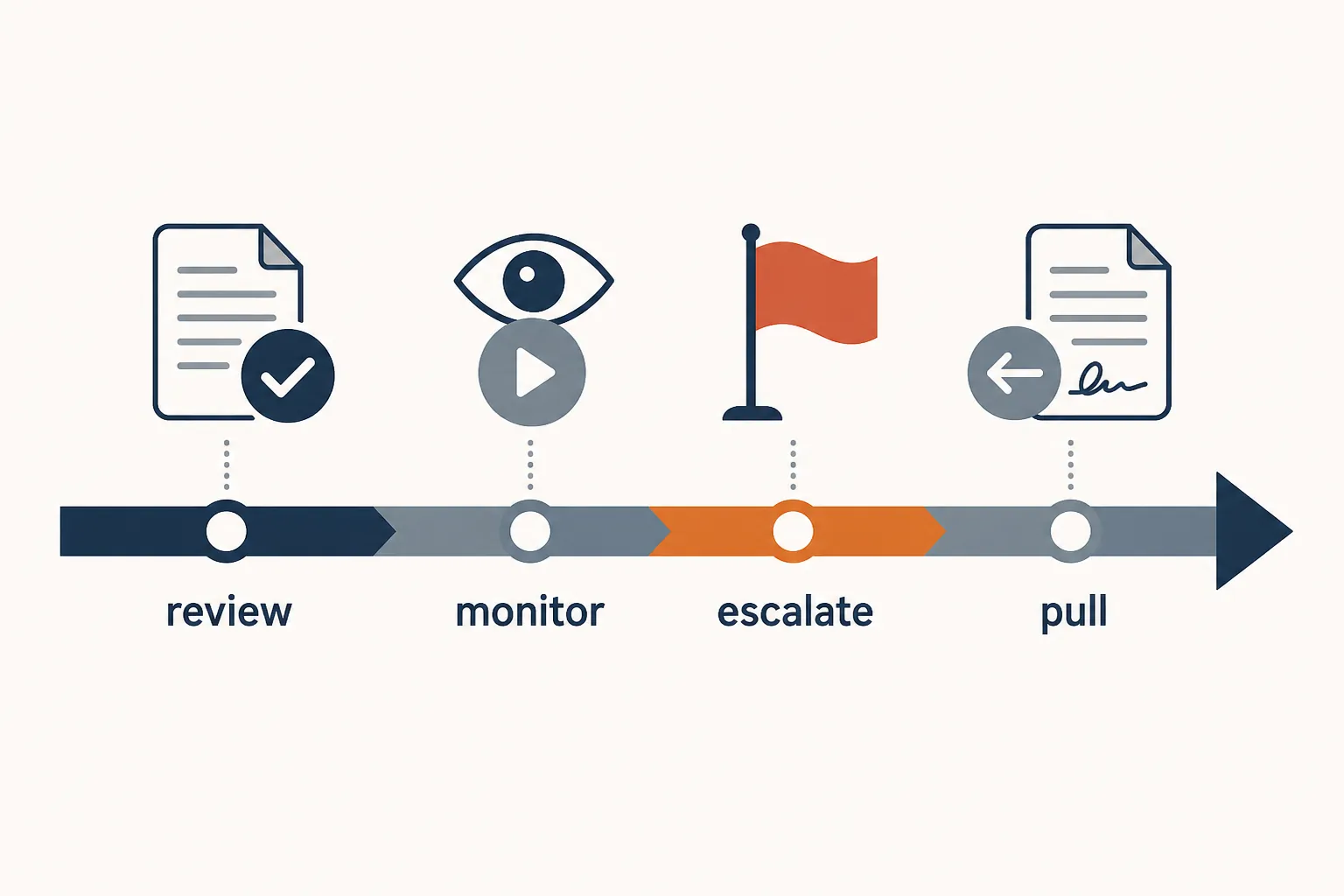
The chronology points to four control moments. They belong in one operating flow because a strong prepublication review still cannot guarantee a harmless outcome, and a rapid response cannot compensate for an approval that nobody can reconstruct.
| Moment in this case | Control to attach | Evidence the operator should retain |
|---|---|---|
| Before the August 21 publication | Contextual review of the final export and all publishing elements by a person with explicit approval authority | Final asset or immutable preview, version, caption, thumbnail, destination, placements, reviewer, timestamp, decision, and conditions |
| Immediately after launch | Confirmation that the published post matches the approved package, followed by active monitoring during the initial response window | Live URL, publication screenshot, platform and account, launch time, comments or alerts reviewed, and assigned owner |
| When objections appear | A predefined escalation route that distinguishes pausing distribution from deciding the final public response | Alert time, person notified, decision owner, actions taken, preserved copies, and stakeholder communications |
| When the brand decides the content must come down | Contractual rights and account access sufficient to pause, remove, or require removal of the asset and connected paid placements | Removal request, applicable contract term, platform action, creator confirmation, and audit of remaining placements |
Review the publication package, not a proxy for it
The control needed before August 21 was not simply “more review.” It was a review object that could later answer a factual question: is this the same video Callaway authorized? The package should include the final edit and every element that changes how it is encountered. For paid amplification, it should also identify the ad account, targeting context, landing page, and planned cutdowns. Approval of an organic creator post should not silently extend to paid use, alternate edits, or other channels.
The reviewer’s authority must be equally specific. A product manager may be able to verify driver claims without accepting reputational risk. A partnership lead may confirm that a creator met the deliverable while lacking authority to approve media from the brand account. The workflow should route unresolved concerns to the designated decision owner instead of allowing an ambiguous acknowledgment to become permission by momentum.
Treat launch as another verification point
Once the video went live, the relevant question changed from “may this publish?” to “what has actually published, and how is it being received?” The operator should compare the live post with the approved package, check that no caption or edit changed at upload, and monitor for signals that require escalation. For a prominent collaboration, assigning that work to a named person is more reliable than assuming someone on the brand, agency, or creator team will notice.
Monitoring does not mean treating every negative comment as a crisis. Its purpose is to detect a material issue early enough to preserve options. The escalation plan can authorize an operator to pause paid distribution or request a temporary hold while executives decide on removal and public language. That prevents the person closest to the platform from waiting for a full committee while reach continues to accumulate.
Pull rights must survive the creator handoff
Creator content often lives on accounts the brand does not control. The contract therefore needs to define who can require a pause or removal, how quickly the creator must respond, whether the rule covers edits and reposts, and what happens to paid amplification, whitelisting, retailer pages, and other derivative placements. The same terms should preserve evidence before deletion so the incident can be investigated without relying on recollection or circulating copies.
Callaway’s removal of its own co-branded product listing illustrates the limits of controlling only brand-owned surfaces. Golf Galaxy separately asked to have its branding removed, and Golf Channel made its own postponement decision.[3][4] A response map should identify those connected parties before launch, including who contacts each one and who is authorized to discuss the incident.
Fast, lightly documented vetting is a broader operating condition
Nothing in the public record proves that Callaway used a rushed manual review, lacked automation, or followed the industry patterns below. Third-party marketer research is useful here only as context for the conditions under which creator programs commonly operate—not as evidence of what happened inside Callaway.
In a June 2025 EMARKETER/Viral Nation survey of 117 U.S. marketers, more than half said they spent 30 minutes or less vetting each influencer. Viral Nation estimated that this amount of review covers roughly 0.01% of a creator’s content history. The same survey found that 81.2% still relied on manual review.[5]
The documentation gap is especially relevant to an approval post-mortem: 96.6% of respondents wanted vetting documentation, but only 25.6% said they always received it. Brand-safety adherence ranked as the top success indicator for 11.1%, compared with 27.4% for performance and 23.1% for engagement.[5] These figures measure reported practices and priorities among the surveyed marketers; they do not measure whether any particular review process was effective.
The report also said 28.2% of marketers cited a lack of automation tools.[5] That is an operational gap, not a causal explanation for this incident. No available source attributes Callaway’s approval to AI or to the absence of AI. Automation might help collect creator history, retain records, or route alerts, but it cannot decide by itself what authority an approval carries or whether the complete publication context is acceptable.
Separate Kolsquare research reported that 55% of consumers ages 18–34 had stopped buying from a brand over a values clash and cited an estimated impact of about $250 million from the Adidas/Ye fallout.[6] Those figures indicate why brands treat values alignment as commercially relevant; they do not predict losses from the Good Good and Callaway episode, whose consequences were still developing at the time of review.
The outcome remains interim
As of August 28, Callaway’s internal and external investigations had not produced a public final finding. The PGA Tour had not announced a final decision concerning the Good Good Championship scheduled for November, and Golf Channel’s postponement had not become a reported final disposition.[1][2][4] Claims beyond those documented actions would outrun a story that was only days old.
The chronology supports a narrower conclusion. Approval is merely recorded permission unless the final asset has been reviewed in context by someone authorized to accept the exposure. Even then, the brand needs monitoring, escalation, and contractual pull rights capable of detecting and reversing a bad decision after launch.
References
- A controversial ad for a driver is the latest clash between golf’s old guard and new world — CNN
- Golf brand Callaway apologizes for part in ad showing woman being shoved to the ground — The Athletic
- Callaway Removes Good Good Driver Listing After Backlash to Needlessly Violent Ad — Inc.
- PGA Tour CEO responds after Callaway, Good Good Golf apologize for ad in which a man shoves a woman to the ground over a driver — Yahoo Sports
- FAQ: The importance of creator vetting for brand safety — EMARKETER
- The Trust Dividend: Brand Safety as a Performance Strategy for Influencer Marketing in 2026 — Kolsquare
This is a record of what happened and what was tested, not legal advice. Compliance determinations require qualified counsel.