
Which Athlete Influencer Tier Should Your Beauty Brand Choose?
A decision framework for beauty brands entering athlete influencer marketing, comparing three partnership tiers — league, team, and individual athlete — with documented costs, activation examples, and ROI profiles to help you match the tier to your specific objective.
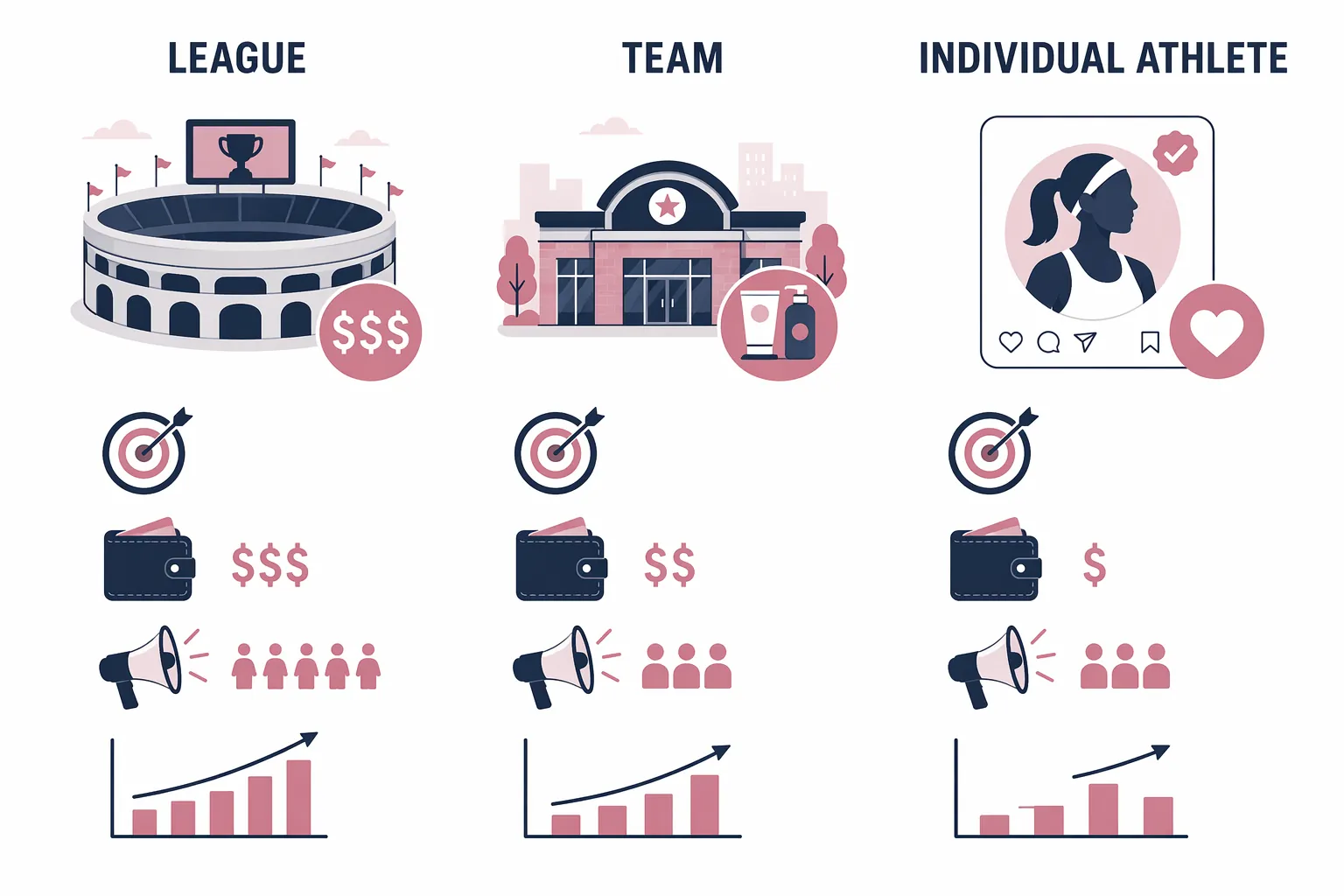
The first decision in athlete influencer marketing for a beauty product is not which athlete looks most “on brand.” It is which partnership tier can do the job in front of the business. A league deal buys legitimacy and national positioning. A team deal buys a place to activate, sample, and show up repeatedly. An individual athlete deal buys trust, routine, and a more direct path from content to conversion.
That distinction matters because the same partnership deck can make all three tiers sound interchangeable. They are not. The assets are different, the internal work is different, and the ROI should not be judged on the same line item.
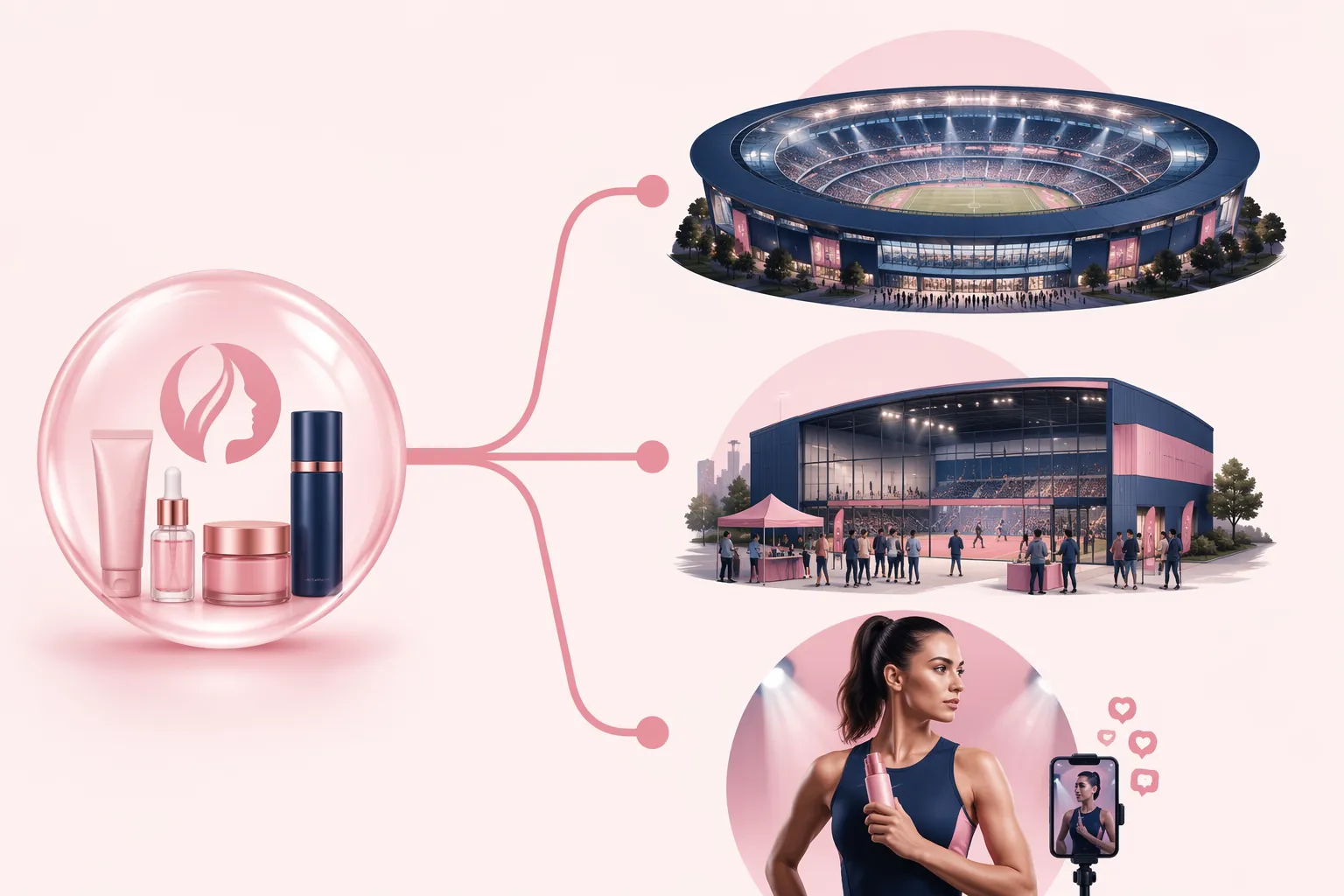
The Tier Decision Matrix
Use the tier choice as a budget allocation decision before it becomes a creative decision. OpenSponsorship has described athlete deal costs directionally from $500 to $500K+, depending on reach, sport, rights, and negotiation; that range is too wide to be useful unless the brand first defines the marketing job.[1] The same discipline applies in broader growth planning: a budget should follow the use case, not the channel label. For a parallel framework, see How to Allocate Your AI Marketing Budget in 2026.
| Tier | Best-fit objective | Cost direction | Media assets | Activation types | Audience access | Operational complexity | ROI profile |
|---|---|---|---|---|---|---|---|
| League | National awareness, category legitimacy, long-term brand positioning | Highest; usually requires larger commitments and multi-year planning | League marks, tentpole moments, national storytelling, broad media credibility | Campaigns, court or facility investments, community programming, league-wide content | Broadest audience, but less intimate than athlete-owned channels | High: legal rights, calendar coordination, approvals, sustained activation budget | Awareness lift, earned media, brand association, retail leverage; slower to attribute to immediate sales |
| Team | Local relevance, community trust, event trial, retail-adjacent activation | Mid to high; generally more accessible than league, but activation costs can be material | Team marks, venue inventory, player-adjacent content where rights allow, local media | Sampling, in-stadium presence, theme nights, fan experiences, community events | Concentrated fan base with repeat touchpoints | Medium: venue logistics, local activation staff, product distribution, team approvals | Trial, purchase intent, local earned media, fan affinity; strongest when product experience matters |
| Individual athlete | Credible social proof, routine-based product storytelling, creator-style conversion | Widest range; from smaller NIL or creator deals to premium professional athletes | Athlete content, usage rights, appearances, affiliate links, paid social amplification | Tutorials, routine videos, launch content, limited editions, ambassador programs | Most personal access through the athlete’s own community | Variable: simpler for content-only deals, higher when exclusivity, usage rights, or appearances are included | Engagement, traffic, affiliate sales, creator content performance; more measurable but less automatically scalable |
This matrix should stop one common mistake: asking a league deal to perform like an affiliate creator, or judging an athlete content partnership by whether it delivers national legitimacy. Those are different machines.
League Deals: Buy Legitimacy Only If You Can Keep Showing Up
A league-level partnership makes sense when the brand needs to be seen as part of the sports ecosystem, not merely adjacent to it. Glossier is the cleanest beauty example because the company did not treat the WNBA as a one-campaign influencer backdrop. It became the first beauty brand to partner with the WNBA in 2020, then expanded the relationship into court renovations, Team USA sponsorship, and community league support, according to Forbes reporting published in July 2025.[2]
That is the point of a league tier: it compounds through continuity. The brand gets a bigger platform, but the platform also asks more from the brand. A press release may open the door; it does not create the business case by itself. The value comes from national awareness, category positioning, repeated association, and the ability to bring that sports credibility into retail conversations, media plans, community investments, and future launches.
For beauty, this tier is especially useful when the brand wants to make a broad statement about performance, routine, confidence, or culture without having the entire message rest on one athlete’s feed. It is less useful when the business problem is immediate product trial in one market, or when the brand has not funded the activation beyond the rights fee.
Team Deals: The Place Where Beauty Mechanics Become Visible
Team partnerships deserve more attention than they usually get because they sit close to the fan and close to the product experience. A mascara, sunscreen, lip product, fragrance mist, or hair color story does not always need a national league platform. Sometimes it needs a venue, a crowd, a local media hook, and a reason to put the product in someone’s hand.
NYX’s Angel City FC partnership shows the team tier’s local logic: in-stadium presence and community engagement around a women’s sports property with a distinct cultural identity.[3] This is not the same buy as a single athlete post. The brand is purchasing a repeatable environment where fans can encounter it as part of the match-day experience.
Sephora’s Golden State Valkyries partnership pushes the tier in a different direction. Glossy reported it as Sephora’s first WNBA team partnership and part of a broader $100 million women’s sports commitment.[4] That matters because it signals both local market entry and corporate-level seriousness. For a retailer, a team partnership can also support regional storytelling, store relevance, beauty services, event programming, and brand partner participation.
La Roche-Posay at the US Open shows the event and venue version of the same logic. The brand distributed more than 400,000 sunscreen packets, and 70% of recipients said they would buy the product after sampling, according to Byrdie.[5] That number measures stated purchase intent after trial, not confirmed sell-through. Still, it is a more concrete outcome than “brand love,” and it fits the product: sunscreen benefits from use, context, and immediate relevance.
The team or event tier is usually the strongest first move when the product needs demonstration or sampling. It gives the beauty team more operational control than a pure athlete content deal and more tangible fan interaction than a top-down league announcement. The tradeoff is execution load: product quantities, venue permissions, staffing, compliance, creative, measurement, and local follow-through all have to be planned before anyone celebrates the partnership.
Individual Athletes: Trust Travels Through Routine
Individual athlete deals are often where beauty feels most natural, because product use can appear inside training, recovery, travel, game-day preparation, or everyday identity. The useful asset is not just reach. It is the athlete’s ability to make a product feel like part of a lived routine rather than a borrowed script.
e.l.f. Cosmetics shows how individual relevance can compound when paired with mass reach. Future Commerce reported that e.l.f.’s Power Grip Primer sold every 8 seconds before its 2023 Super Bowl ad and every 3.5 seconds after.[6] The lesson is not that every brand needs a Super Bowl buy. It is that athlete and sports relevance can become more commercially powerful when the brand connects creator credibility, product clarity, and mass distribution.
Katherine Legge is a useful beauty partnership signal for the same reason: motorsports gives the product story heat, endurance, visibility, and performance conditions. The athlete’s credibility does some work that a studio beauty shoot cannot. The brand still has to make the conversion path obvious through product availability, landing pages, paid amplification, and usage rights.
Maybelline’s work with Ilona Maher belongs in this tier because Maher’s public appeal is not separated from her athletic identity. Fashion Magazine has covered female athletes as beauty ambassadors in this newer cycle of brand investment, including high-visibility athlete partnerships that blend performance, personality, and product storytelling.[7] For a beauty marketer, the buying question is whether the athlete’s audience trusts her taste enough to move from admiration to trial.
College and NIL activity widens the individual tier but also complicates measurement. Modern Retail reported in January 2026 that Madison Reed’s UConn Team Color Wonder program includes cash, equity stakes, franchise opportunities, for-credit internships, and what it described as the first-known signature athlete hair color shade, “UConnic Blonde.” The same reporting cited College Sports Commission data showing 12,175 approved NIL deals totaling $87 million, while noting that approved or cleared deal counts may undercount total negotiated activity.[8]
That caveat matters. NIL data can make the market look more neatly measurable than it is. For an individual athlete deal, the brand should separate fee, product seeding, usage rights, whitelisting, exclusivity, appearance obligations, affiliate structure, and content volume. A low headline fee can become expensive if the brand later needs paid usage, and a higher fee can be efficient if the content drives retail, paid social, and earned media at once.
The Market Context Is Real, But It Is Not the Strategy
The reason this channel is getting budget is not mysterious. Forbes and Byrdie have cited women’s sports viewership growth of 170% year over year, and the female share of major sports audiences is not niche; Forbes, Byrdie, and Future Commerce have all cited women as 47% of the NFL audience.[2][5][6] The current beauty partnership landscape also skews heavily toward female athletes and women’s leagues because that is where many documented beauty deals are concentrated. That reflects present market activity, not a rule that beauty can only work with women athletes.
The performance signals are encouraging, but they should be dated and scoped. OpenSponsorship has reported a 5.6% athlete influencer engagement rate versus a 2.4% average influencer rate, or 2.3 times higher, using data that appears to span the 2023–2024 period and later updates.[1] Savanta reported in August 2024 that brands earn $5.78 to $7.00 per $1 spent with athletes.[9] Wasserman has reported that female athletes drive twice the social media engagement of male athletes.[10] Nielsen has found women’s sports fans are 25% more likely to purchase a sponsor brand than men’s sports fans.[11] ParityNow has reported that daily or weekly women’s sports viewers are 3.5 times more likely to buy a product promoted by a female athlete.[12]
Those facts support serious consideration. They do not remove the need for tier discipline. Engagement advantages do not tell a brand whether to buy a league sponsorship, a team activation, or an athlete ambassador. Sponsor purchase intent does not guarantee sell-through. Revenue forecasts for women’s sports also vary by source, scope, and year, so they should not be blended into one inflated market-size claim.
Measure Each Tier Against the Job It Was Hired to Do
A league deal should carry awareness and positioning metrics: aided and unaided awareness, share of voice, earned media quality, brand association, retail buyer response, and the value of reusable rights. It can influence sales, but if the business case depends on a clean last-click path, the brand is probably buying the wrong tier.
A team or event deal should be measured closer to the ground: samples distributed, qualified interactions, QR scans, email or SMS capture, local store lift where trackable, purchase intent, social mentions, earned local media, and repeat activation efficiency. La Roche-Posay’s US Open sampling result belongs here because the outcome was tied to trial and stated intent, not abstract affinity.[5]
An individual athlete deal can carry more direct response measurement: engagement rate, saves, comments, click-through, affiliate sales, promo-code usage, content hold rate, paid social performance, and creator licensing value. The brand should also track whether the athlete’s content improves paid media efficiency after whitelisting, because the best creator assets often earn their keep beyond the original post.
The practical mistake is forcing all three into one ROI column. Awareness, trial, and social conversion are different returns. They can sit in one portfolio, but they should not be scored as if they are the same channel. That use-case view is similar to the framework in Where AI Marketing ROI Actually Pays Off (and Two Places It Doesn't): the question is not whether a category “works,” but where the return actually appears.
What to Buy
Choose league when the brand needs national legitimacy, a durable category position, and enough budget to activate beyond the announcement. Glossier’s WNBA path is persuasive because it is multi-year and multi-surface, not because it resembles a standard influencer buy.[2]
Choose team when the brand needs community presence, product trial, and a physical or local reason to believe. NYX, Sephora, and La Roche-Posay show why this tier is attractive for beauty: it can turn sports attention into venue presence, sampling, regional relevance, and measurable intent.[3][4][5]
Choose individual athletes when the brand needs trusted social proof, content that can travel, and a clearer path toward conversion. This tier is strongest when the product belongs naturally in the athlete’s routine and the contract gives the brand enough rights to use the content where it performs.
The decision rule is simple enough to bring into budget planning: buy league for legitimacy, team for trial, and individual athletes for trust-led conversion. If the proposed partnership cannot name which of those jobs it is doing, the brand is not buying strategy. It is buying a moment.
References
- Sports Influencer Marketing Stats Brands Must Know, OpenSponsorship, 2023/2026
- Beauty Brands Are Investing In Women's Sports. Here's Why, Forbes, July 2025
- Beauty Brands Are Cashing In on Sports Culture, SportsVerse
- Sephora Strategies: Inside Sephora's big bets on women's sports, Glossy
- Women's Sports Are the Beauty Industry's Lucrative New Partnership Opportunity, Byrdie
- Game Face: How Beauty Brands Are Scoring Big with Women's Sports, Future Commerce
- Female Athletes Are the New Beauty Brand Ambassadors, Fashion Magazine
- Fashion and beauty brands are expanding deals with college athletes, Modern Retail, January 2026
- Partner with a sports influencer to guarantee victory for your brand, Savanta, August 2024
- Female athletes drive 2x the social media engagement of male athletes, Wasserman
- Women's sports fans are 25% more likely to purchase a sponsor brand than men's sports fans, Nielsen
- Daily and weekly women's sports viewers are 3.5x more likely to buy a product promoted by a female athlete, ParityNow
This is a record of what happened and what was tested, not legal advice. Compliance determinations require qualified counsel.