
How AI Video Analysis Serves Both Security and Marketing
Retailers can use the same AI camera systems for security monitoring and marketing analytics, but successful dual-use deployments require deliberate choices about edge versus cloud processing, data retention policies, and privacy architecture. This article explains what those choices are and how to evaluate vendor claims.
The useful question in AI video analysis for security and marketing is not whether a camera can produce more than footage. It can. The harder question is whether a retailer can let the same camera estate support incident review, theft reduction, traffic counting, queue monitoring, dwell-time analysis, and layout decisions without turning every department’s wish list into one unmanaged data pool.
That is where many budget conversations go soft. Security wants searchable clips. Marketing wants store-flow data. Operations wants queue alerts before customers abandon a lane. Legal wants to know what is being stored, for how long, and whether “anonymous” means technically non-identifying or simply hidden from the dashboard. A vendor can put all of those outputs on one screen. That does not mean the underlying system is governed as one responsible system.
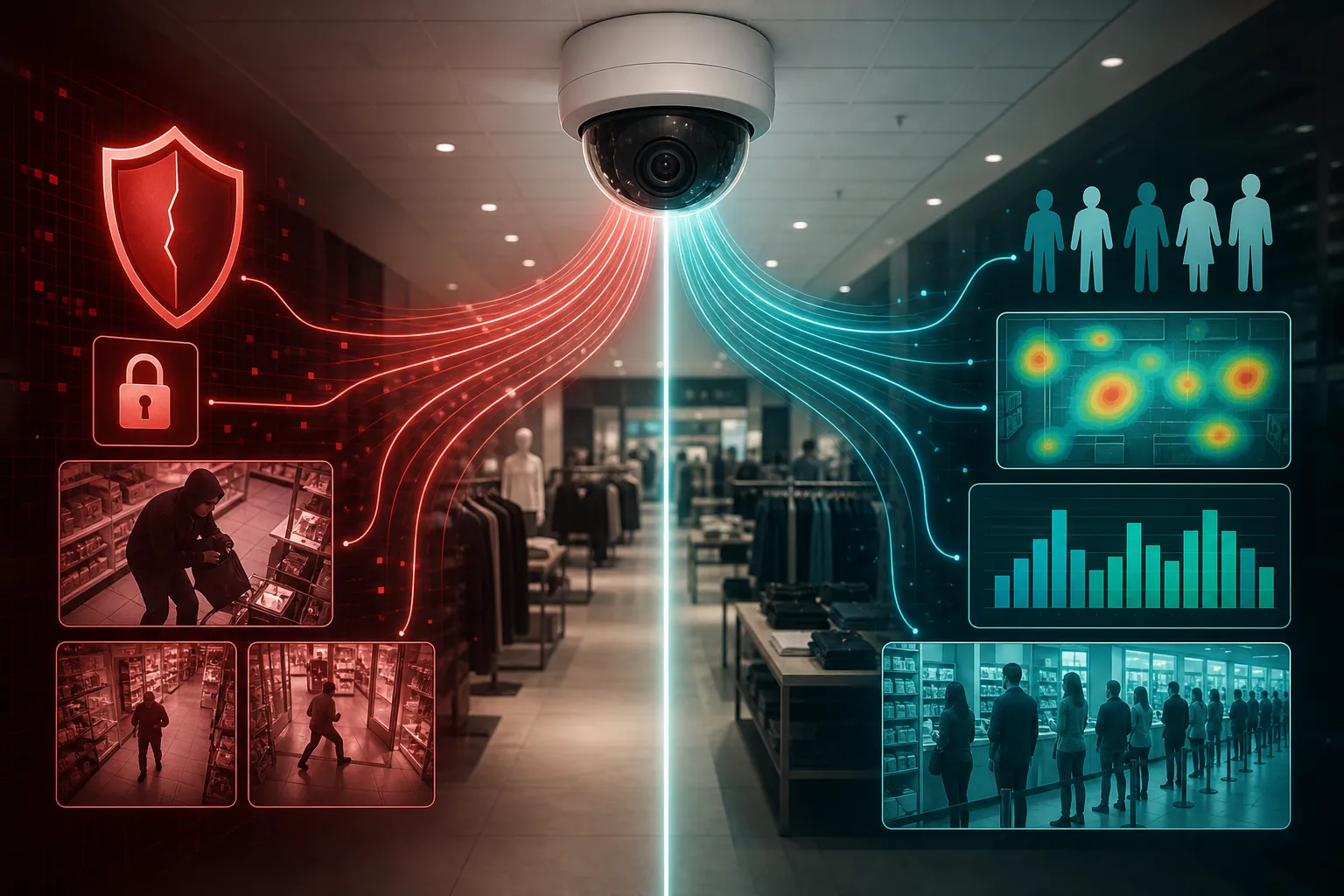
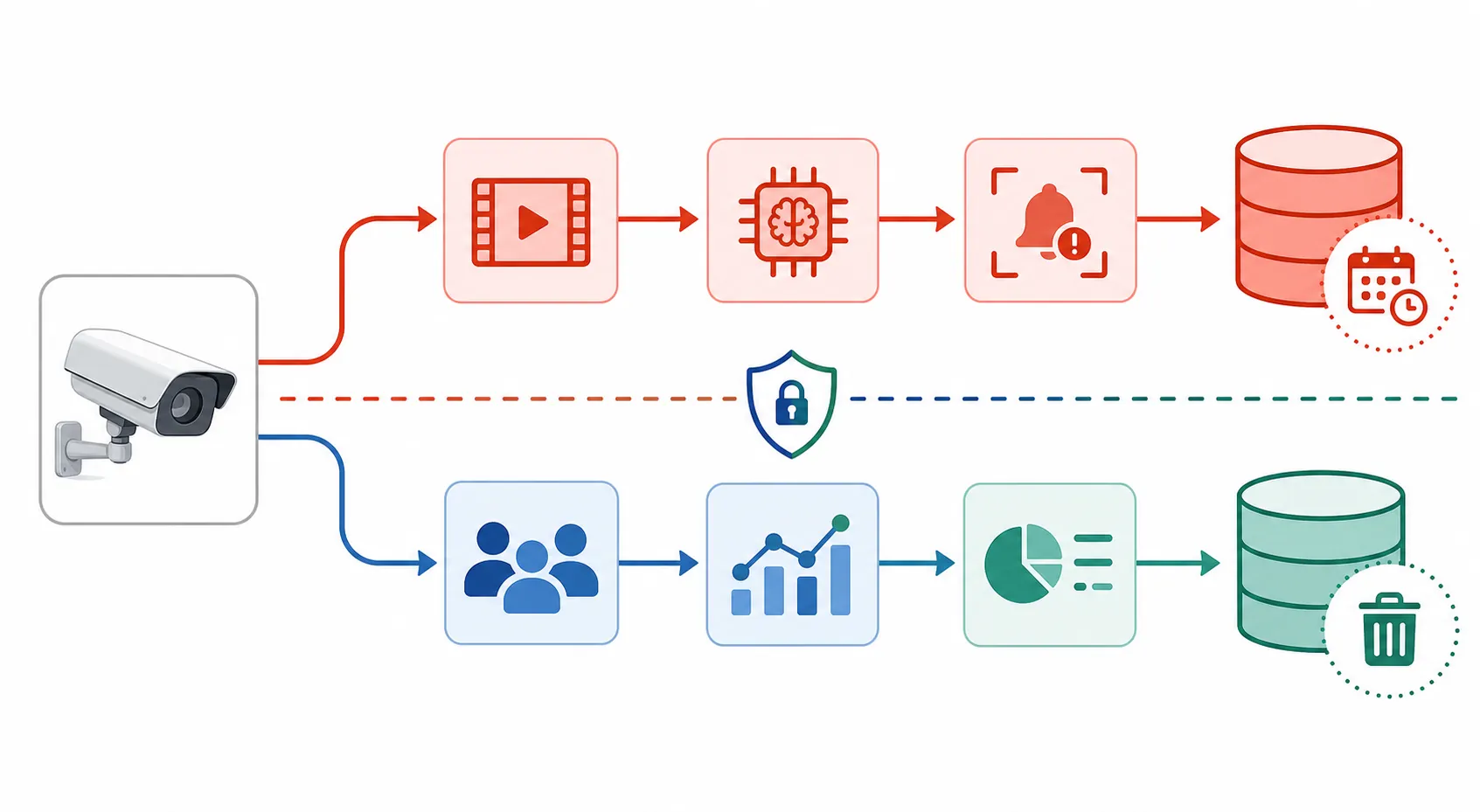
The credible version of dual use starts with separation. Shared cameras and edge hardware can make economic sense. Shared raw video access, shared identity logic, and shared retention defaults usually do not. A security incident record and a marketing heatmap are different artifacts, even when they originate from the same lens.
The best proof is a workflow that changes
Sam’s Club is the cleanest named example because the value is not abstract. Its AI-powered exit technology uses computer vision to verify basket payment at the exit, and the reported deployment across more than 120 locations reduced exit time by 23% while also reducing theft, according to a 2026 retail computer-vision analysis citing Sam’s Club and NVIDIA materials.[1]
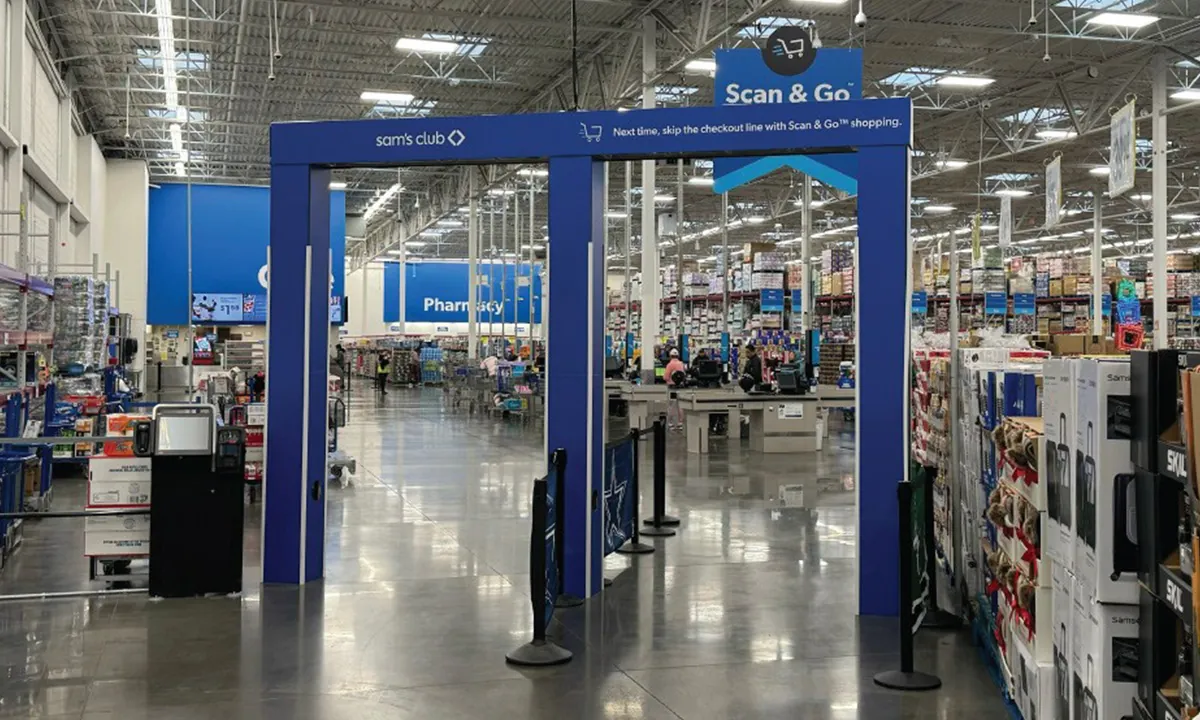
That matters because the system is not just “security with AI added.” It changes the member exit process. The member waits less. The store reduces manual receipt checks. Loss prevention still gets a control point. Operations gets throughput. The overlap is visible in the workflow, not buried in a market forecast.
Kroger sits on the other side of the same category. A 2026 retail computer-vision guide reports that Kroger used dwell-time analysis to redesign key store sections and achieved a 12% conversion lift.[2] That is a marketing and merchandising use case, not an incident-response one. But it depends on the same broad class of camera-derived spatial intelligence: where shoppers pause, how long they stay, and which zones fail to convert attention into action.
Those two cases should not be flattened into “AI cameras improve everything.” They show something narrower and more useful: camera infrastructure can create value for more than one department when the output is tied to a specific decision. Verify a basket faster. Redesign a section. Open a lane before the line becomes a complaint. Review a loitering alert without asking marketing to keep identifiable shopper histories.
What should run at the edge, and what can leave the store?
The architecture choice comes before the dashboard choice. In a dual-use deployment, edge processing is attractive because the camera or nearby device can detect events, count objects, classify movement, and trigger alerts without sending every frame to a cloud repository. Cloud processing may still be useful for fleet-wide model updates, centralized reporting, or cross-store benchmarking, but that does not require every store to upload raw video by default.
| Question | Security pipeline | Marketing or operations pipeline |
|---|---|---|
| What is detected? | Intrusion, loitering, slip-and-fall, suspicious activity, policy violations | Traffic counts, dwell time, queue length, zone engagement, shelf conditions |
| What should be stored? | Event clips, investigation notes, access logs, escalation history | Aggregated counts, zone-level metrics, trend data, deleted or non-retained frames |
| Who needs access? | Loss prevention, security operations, authorized investigators, sometimes legal | Marketing, merchandising, store operations, labor planning |
| What is the retention logic? | Long enough for incident investigation, claims, and documented security policy | Short-lived or non-retained raw data; longer-lived anonymous aggregates |
| What is the main failure mode? | Missed incidents, false alarms, overbroad access, excessive footage retention | Re-identification risk, misleading attribution, zone data that cannot support decisions |
This is the first place to test a vendor’s “one system does everything” claim. Ask which models run locally. Ask whether raw video leaves the store for ordinary queue analytics. Ask whether heatmaps are created from transient detections or from persistent shopper tracks. Ask whether a regional marketing manager can export clips, or only aggregate zone metrics. If the answer is “it depends,” the next question is who configures that dependency and who audits it.
Retailers do not need to make every analytic local. They do need to know which analytics are local. A shelf condition alert, a queue-length estimate, or a person-counting event may be processed near the camera and forwarded as metadata. An incident clip may be retained because a threshold was crossed. A monthly traffic trend does not need the same data trail as a suspected theft event.
Anonymous counts are not the same thing as harmless data
Marketing teams usually do not need faces. They need flow: entrances, exits, departments visited, dwell time, queue length, and patterns by hour or daypart. The stronger retail computer-vision deployments described in 2026 analysis focus on baskets, shelves, and anonymous store flow rather than shopper identity.[1]
But “anonymous” deserves pressure. A dashboard can avoid displaying names and still rely on persistent IDs, session tokens, face templates, device linkages, or cross-camera tracks that create re-identification risk. The practical distinction is between data that is technically minimized at capture and data that is merely presented in an anonymous-looking report.
A defensible marketing pipeline should be able to answer plain questions:
- Are individual shoppers assigned persistent identifiers across cameras, visits, or days?
- Are faces detected only to exclude identity, or are face embeddings created and stored?
- Can raw frames be reconstructed from the data used for heatmaps or dwell-time reports?
- Can marketing users export video, or only aggregate metrics by zone and time period?
- Does the system automatically delete transient analytic data after aggregation?
If the vendor cannot separate those answers from the security configuration, the system is not really dual-purpose. It is a surveillance system with a marketing tab.
Retention policy is where the shared-camera idea either matures or breaks
Security teams have legitimate reasons to retain incident clips. A suspected theft, a fall, a workplace safety event, or a late-night intrusion may require review, escalation, insurance support, or law-enforcement cooperation. The retention period should be explicit, role-based, and tied to a policy the business is willing to defend.
Marketing aggregates follow a different logic. A store may need to compare traffic by entrance over several weeks, study queue pressure during seasonal peaks, or measure whether a reset improved dwell time in a department. That does not automatically justify retaining the underlying video or maintaining shopper-level histories. The business value sits in the aggregate pattern, not in the identifiable path of a person through the store.
This difference should be visible in the contract and the admin console. Incident clips should have retention schedules, access logs, and investigation workflows. Anonymous aggregates should have deletion rules for raw inputs, limits on export, and clear boundaries around whether persistent tracking exists. If the system retains everything first and sorts out purpose later, the retailer has accepted the riskiest version of dual use before seeing whether the use cases perform.
The business case can use ROI benchmarks, but should label them correctly
The category is growing quickly, although market-size estimates vary by scope. Research and Markets puts the AI video analytics market at $27.64 billion in 2026 and projects it to reach $86.21 billion by 2030 at a 32.9% CAGR.[3] That figure is context, not proof that any individual retailer should buy a system. Broader and narrower market definitions can produce very different totals, especially when reports include or exclude adjacent non-AI video tooling.
Operational benchmarks are more useful for a budget case, but the available figures need a label. Forasoft’s 2026 security playbook reports that 86% of end users see ROI within 12 to 18 months, false alarms can be reduced by up to 90%, and incident response time can fall from 4.2 minutes to 1.3 minutes.[4] Those are vendor-published figures, not independent third-party audit results. They can still help frame a business case, but they should not be treated as guaranteed outcomes.
The same caution applies to marketing and operations numbers. Trantor’s 2026 retail guide reports that retailers using computer vision for shelf monitoring see 30% fewer stockouts and 20% faster replenishment cycles.[2] Those figures are directionally useful when comparing labor savings, availability improvements, and customer-experience benefits. They do not replace a pilot that measures the retailer’s own baseline: current false alarms, current shrink patterns, current queue abandonment, current stockout frequency, and current conversion by zone.
A serious internal model should avoid averaging all benefits into one blended AI number. Security savings and marketing lift have different owners, different proof standards, and different time horizons. Reduced false alarms may show up quickly in monitoring workload. A layout change may need several selling cycles. Queue optimization may depend as much on staffing rules as on the camera alert. Treating those returns separately makes the combined investment easier to govern.
Facial recognition changes the procurement conversation
Most dual-use retail deployments do not need continuous facial recognition, and adding it changes the risk profile immediately. A system that counts shoppers, detects queues, flags loitering, or monitors shelves can often operate without identifying people. A system that creates or matches biometric templates introduces consent, retention, access, and purpose-limitation questions that cannot be solved by calling the output “analytics.”
Regulators and courts are already setting hard boundaries. EU AI Act Article 5 prohibitions on untargeted facial scraping are in force, with fines up to €35 million or 7% of global turnover.[4] Forasoft also reports more than 100 BIPA class actions in 2025, with published settlements ranging from $1.857 million to $8.75 million.[4] State biometric laws in Illinois, Texas, and Washington require written consent and documented retention schedules, according to Coram’s 2026 privacy analysis.[6]
This does not mean every retailer must reject every identity feature. It does mean identity features should not arrive as silent defaults. Coram describes an opt-in pattern in which features are disabled by default and facial recognition is gated behind investigation-specific configuration.[5] That is the kind of boundary a buyer should look for: not a privacy slogan, but a product behavior that prevents broad biometric use unless someone with authority turns it on for a defined purpose.
How to interrogate the “single platform” pitch
A single platform is not automatically a problem. Fragmented systems create their own mess: duplicate cameras, inconsistent alerting, incompatible exports, and nobody responsible for the full estate. The issue is whether the platform lets the retailer govern different uses differently.
The vendor conversation should get concrete early. A product demo may show a clean view of incidents, traffic, heatmaps, and queue trends. Procurement should push underneath that view and ask for the data path.
- Inference location: Which detections run on the camera, which run on an edge appliance, and which require cloud processing?
- Raw video movement: Does ordinary marketing analytics require raw footage to leave the store, or are only events and aggregates transmitted?
- Identity handling: Are face templates, gait signals, persistent shopper IDs, or session tokens created for any marketing or operations feature?
- Retention defaults: How long are incident clips, non-incident video, analytic metadata, and aggregate reports retained by default?
- Access separation: Can marketing, operations, security, legal, and IT be assigned different permissions by data type rather than by dashboard module?
- Feature gating: Are biometric or identity-sensitive features disabled by default, and is activation limited to specific investigations or approved locations?
The answers should be documented in the statement of work, not left to a post-installation admin training. If marketing only needs aggregate dwell time by department, the system should not expose searchable shopper journeys to marketing users. If loss prevention needs incident review, that does not give merchandising a reason to retain clips from every aisle reset. If legal requires a biometric retention schedule, the vendor should be able to show where that schedule is configured and logged.
Buyers should also ask how model performance is monitored after launch. A queue alert that misses holiday traffic is an operations problem, not just a model metric. A heatmap that cannot be exported by zone may be useless to merchandising even if the dashboard looks impressive. A false-alarm reduction claim has little value unless the retailer knows its current false-alarm rate, camera placement, alert thresholds, staffing process, and escalation rules.
Shared hardware, separate ownership
The organizational design matters almost as much as the technical design. Dual-use systems fail when ownership is vague. Security cannot be the only owner if marketing and operations depend on the data. Marketing cannot define analytics requirements without accepting privacy and retention constraints. IT cannot be left to discover after deployment that cloud upload, bandwidth, storage, and identity controls were assumed but never priced.
A workable operating model names owners by pipeline. Security owns incident policy, review rights, escalation paths, and footage retention. Marketing or merchandising owns approved aggregate metrics, zone definitions, reporting cadence, and test design. Operations owns queue thresholds, labor-response rules, and store execution. Legal and privacy teams approve biometric restrictions, consent requirements, signage language, and retention schedules. IT owns integration, device management, access control, and vendor security review.
That may sound heavier than a camera purchase should be. It is still lighter than discovering six months later that the queue system cannot support the labor model, the marketing export contains more detail than expected, security wants longer retention than the contract priced, and legal is asking why an optional face feature was enabled in a pilot store.
What a defensible dual-use deployment looks like
The strongest deployments do not ask every department to accept the same data bargain. They use shared camera infrastructure where that reduces cost and complexity, then separate the outputs by purpose.
- Security analytics create event-driven records with restricted access, investigation workflows, and documented retention.
- Marketing analytics use anonymous or minimized data, aggregate results by zone and time, and avoid persistent identity unless there is a separate approved purpose.
- Operations analytics trigger timely actions, such as opening lanes or checking shelves, instead of only producing retrospective dashboards.
- Biometric features are off by default, separately approved, and governed through consent and retention controls where required.
- ROI is measured by baseline-specific outcomes rather than borrowed wholesale from vendor benchmarks.
That standard leaves room for ambitious systems. It just refuses to let a dashboard substitute for architecture. Dual-use AI video analysis is credible when security and marketing operate as separate governed pipelines on shared hardware. It is risky when a vendor collapses incident review, shopper analytics, retention, identity, and access into one undifferentiated surveillance-and-analytics promise.
References
- AI Computer Vision in Retail: 10 Updated Directions (2026) — Yenra
- Computer Vision in Retail: A Complete Guide for 2026 — Trantor
- AI Video Analytics Market Report 2026 — Research and Markets
- AI-Powered Video Analytics: The 2026 Security Playbook — Forasoft
- 11 Best AI Video Analytics Companies in 2026 for Smart Surveillance — Coram AI
- AI Surveillance Privacy Concerns in 2026 — Coram AI
This is a record of what happened and what was tested, not legal advice. Compliance determinations require qualified counsel.